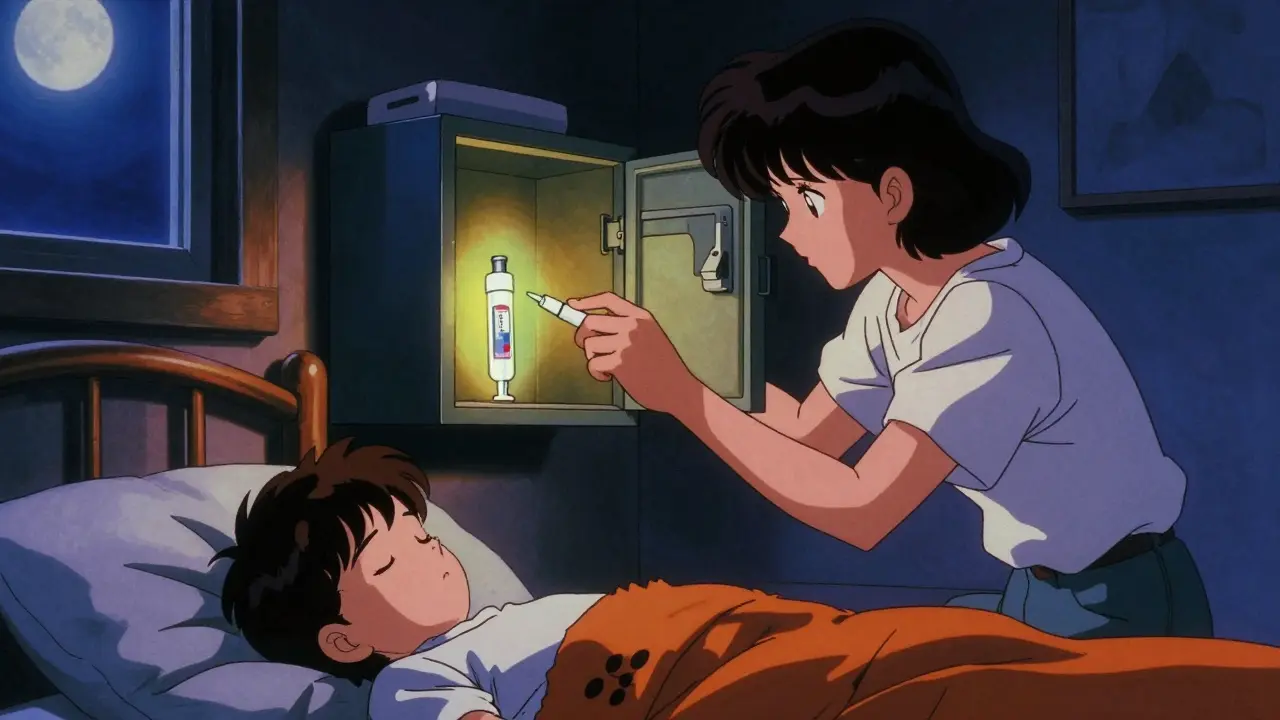
Keeping emergency medications like epinephrine, naloxone, or nitroglycerin both accessible and secure isn’t just a good idea-it’s a lifesaving balance. Too locked up, and you risk delaying care in a crisis. Too easy to reach, and you put kids, pets, or someone else at risk of accidental overdose or misuse. This isn’t about following rules-it’s about making sure the right person can grab the right medicine at the right moment, every time.
Understand What Counts as an Emergency Medication
Not all meds are created equal. Emergency medications are the ones meant to be used quickly when seconds matter. Think epinephrine auto-injectors for severe allergic reactions, naloxone for opioid overdoses, nitroglycerin for heart attacks, or albuterol inhalers for sudden asthma attacks. These aren’t daily pills you can wait to take. They’re tools you need to act on immediately. That’s why storage can’t be an afterthought.The FDA and CDC agree: these drugs must be stored where they’re easy to find but hard to accidentally get into. That means no more leaving them on the kitchen counter, in a bathroom cabinet, or tucked under a child’s toy. A 2022 FDA review found only 43% of prescription labels even include clear storage instructions. So you can’t rely on the box-you need to know the rules yourself.
Home Storage: Lock It, But Not Too Tight
In a home setting, the goal is simple: keep it away from children and pets, but within arm’s reach of the person who might need it-or the caregiver who can help. The EPA recommends a locked cabinet, closet, or medicine safe. But here’s the catch: if it’s behind three locks and a code you forget under stress, it’s useless.Best practice? Use a small, portable medicine safe with a key or combination. These cost between $20 and $60 and are widely available online or at pharmacies. Look for ones with a quick-release mechanism-no fumbling with tiny keys in a panic. Keep it in a high cupboard, in a bedroom closet, or even mounted on a wall near the bed. Avoid the bathroom. Humidity and temperature swings can ruin epinephrine and other sensitive drugs.
For households with kids, the American Academy of Pediatrics says: never store emergency meds in the same place as routine meds. Keep epinephrine or naloxone separate, clearly labeled, and always ready. If you have a child with severe allergies, make sure teachers, babysitters, and family members know exactly where it is-and how to use it. Practice the steps. Muscle memory saves lives.
EMS and Vehicles: Locked, but Always Ready
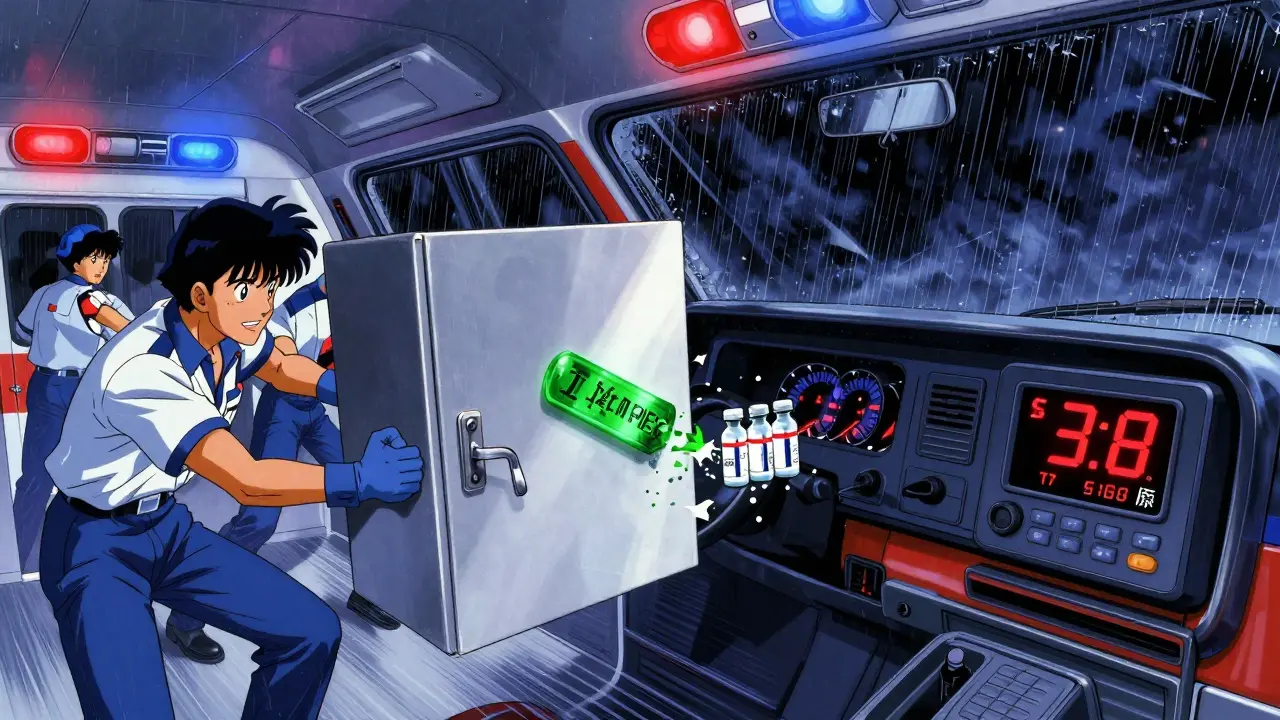
In ambulances and emergency vehicles, storage is strictly regulated. According to Nevada EMS guidelines (NVERS, 2024), medications must be kept in lockable cabinets that stay secured when not in use. Keys or access codes are restricted to authorized personnel only. But here’s what most people don’t realize: these cabinets aren’t meant to be vaults. They’re designed for rapid access during transport.Modern EMS units use tamper-evident seals and electronic logs. If someone opens the cabinet, it records the time, who accessed it, and why. This isn’t surveillance-it’s accountability. It protects patients and providers. Temperature control is just as critical. Epinephrine, for example, loses potency if exposed to heat above 40°C (104°F). That’s why many EMS agencies now use portable temperature monitors. The FDA-approved TempTraq system, tested by the University of Michigan in 2022, alerts crews if meds are getting too hot or cold.
And yes-there’s a real risk of delay. A 2022 National EMS Survey found 17.3% of providers had experienced a situation where security protocols slowed down access. That’s why training is non-negotiable. EMS teams spend 4-6 hours learning exactly how to open, check, and replace emergency meds without wasting a second.
Hospitals and Clinics: The Balance of Speed and Safety
In hospitals, emergency meds are stored differently depending on the unit. In the ER or ICU, code drugs are often kept on open carts within sight of staff. Why? Because in cardiac arrest, every second counts. But these carts have tamper-evident locks. If someone tries to open them without authorization, it’s obvious. The Joint Commission requires this balance: secure enough to prevent theft, open enough to save lives.For controlled substances like morphine or fentanyl, federal law (DEA regulations) demands they be stored in separate, substantially constructed cabinets with locked doors. These aren’t ordinary lockboxes. They’re built to resist forced entry. And they’re tracked. Every time one is opened, the system logs it. This isn’t bureaucracy-it’s a response to the 5,223 incidents of controlled substance theft or loss reported by the DEA in 2022.
Operating rooms take this further. The American Society of Anesthesiologists says meds must be secured with tamper-evident devices that authorized staff can break open quickly. That means a seal that snaps easily when you need it-no keys, no codes, just a clean tear. It’s the same idea as a tamper-proof bottle cap, but for life-or-death situations.
Childcare and Schools: Accessibility Without Risk
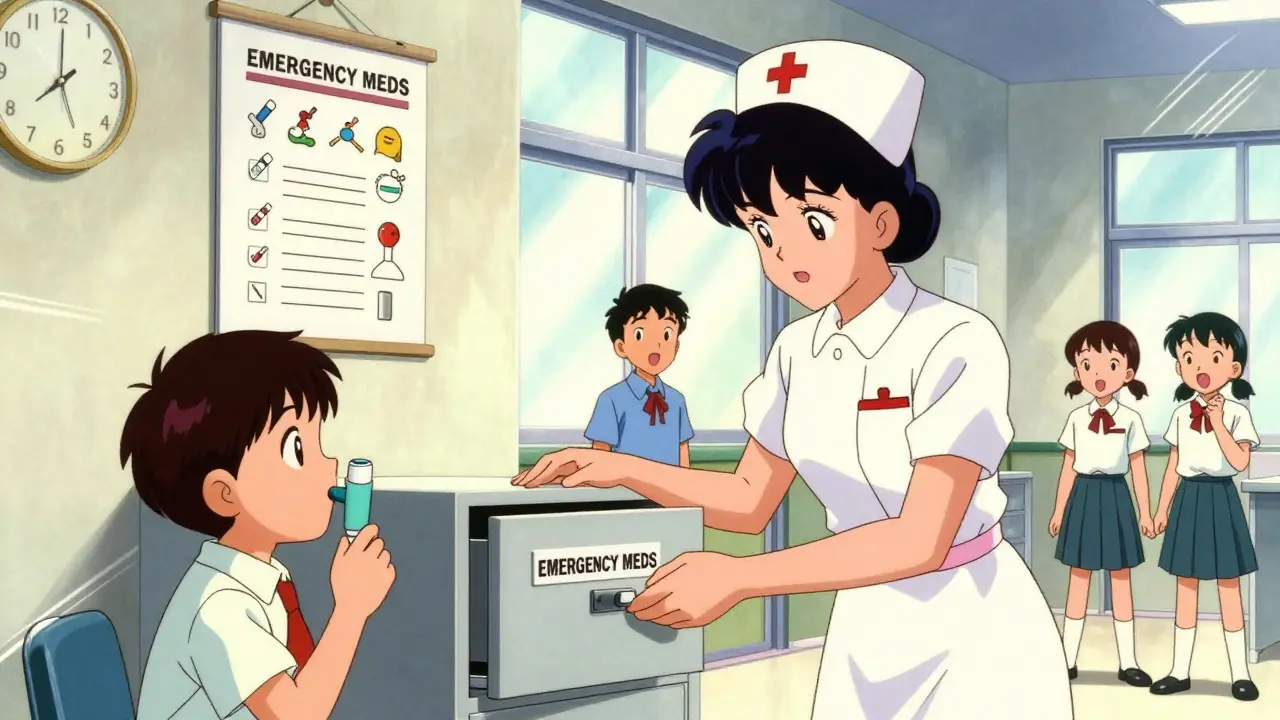
In daycare centers and schools, the rules are different again. The CDC’s PROTECT Initiative and Child Health Connection (2021) state that emergency meds like epinephrine or albuterol for children with known conditions don’t need to be locked away. But they must be stored out of children’s reach. That means a locked drawer in the nurse’s office-not a desk, not a backpack, not a purse.Here’s the real challenge: staff turnover. New aides, substitute teachers, part-time nurses. They need training. A 2023 study in the American Journal of Health-System Pharmacy found that 85% of staff became competent after just two training sessions. That’s it. Two hours of practice, clear labels, and a simple checklist. No need for complex systems. Just clarity.
And don’t forget: if a child has an emergency med, the school must have a written plan. Who can give it? Where is it kept? What’s the backup if the nurse is out? These aren’t optional. They’re required by law in most states.
Temperature Matters More Than You Think
You can lock a med in a safe, but if it’s too hot or too cold, it won’t work. Epinephrine auto-injectors? They degrade fast above 25°C (77°F). Some manufacturers say refrigerate. The American Heart Association says room temperature is fine. The FDA acknowledges this confusion. So what do you do?Follow the manufacturer’s label. If it says “store at room temperature,” keep it between 15°C-30°C (59°F-86°F). That’s a typical home or car interior-not the dashboard in summer. If it says “refrigerate,” keep it at 2°C-8°C (36°F-46°F). But never freeze it. And never leave it in a hot car, even for 10 minutes.
For those who travel or live in extreme climates, portable temperature monitors are a game-changer. They’re the size of a keychain, cost under $50, and alert you via phone if your meds are at risk. The FDA now encourages these tools as part of its 2023 Digital Health Innovation Action Plan.
What to Avoid
- Don’t store meds in the bathroom-humidity ruins them.
- Don’t leave them in a purse, glove box, or drawer with no lock.
- Don’t assume someone else knows where they are.
- Don’t ignore expiration dates. Epinephrine loses potency after expiry-sometimes before.
- Don’t mix emergency meds with routine pills. Label everything clearly.
Future Trends: Smarter Storage Is Coming
The market for pharmaceutical security is growing fast. It was worth $8.7 billion in 2023 and is projected to hit $14.2 billion by 2028. Why? Because people are realizing that security isn’t just about locks-it’s about smart systems.By 2027, Gartner predicts 65% of healthcare facilities will use AI-powered systems that adjust access based on real-time risk. Think: if a nurse is in the ER and a code is called, the system unlocks the med cabinet automatically. If someone tries to open it at 3 a.m. without a valid reason, it alerts security. This isn’t sci-fi-it’s already being tested in major hospitals.
For home users, companies are launching smart medicine safes with biometric locks, app alerts, and remote access for caregivers. Imagine getting a text if your parent’s naloxone box was opened-and knowing it was the EMTs, not a child.
But until then, stick to the basics: lock it, label it, check the temp, train the people around you, and never assume it’s fine.
Can I keep emergency medication in my car?
It’s not recommended. Car interiors can hit over 40°C (104°F) in summer, which can destroy epinephrine, insulin, or other temperature-sensitive drugs. If you must, use a temperature-controlled portable case and check it weekly. Better yet, keep it at home or work, where you can control the environment.
What if I’m not sure if my epinephrine is still good?
Check the color. Epinephrine should be clear and colorless. If it’s pink, brown, or has particles in it, throw it out. Also check the expiration date. Even if it’s not expired, if it’s been exposed to heat or light, it may not work. When in doubt, replace it. A new injector costs less than an ER visit.
Do I need a special safe for naloxone at home?
No special safe is required, but you need a secure, locked container that children and others can’t access. A small lockbox, a locked drawer, or even a high cabinet with a childproof latch works. The goal is to prevent accidental use, not to make it hard to find in an emergency. Keep it near your front door or in your bedroom-somewhere you and your family can reach quickly.
How often should I check my emergency meds?
Check every three months. Look at the expiration date, the color, and the packaging. If it’s been dropped, exposed to heat, or the seal is broken, replace it. Set a calendar reminder. For epinephrine and naloxone, replacing them before they expire is cheaper-and safer-than waiting for a crisis.
Can I store emergency meds with my regular prescriptions?
No. Mixing them increases the risk of confusion. Emergency meds need to be clearly labeled and stored separately. If you’re in a panic, you shouldn’t have to search through ten different bottles. Keep epinephrine, naloxone, or nitroglycerin in its own labeled container, and make sure everyone who might need it knows exactly where it is.
Next Steps
- Find your emergency meds right now. Are they where you think they are?
- Check the expiration date and color. Replace if needed.
- Teach one person how to use it. Your partner, your teen, your neighbor.
- Buy a small medicine safe if you don’t have one. Under $50. Worth it.
- Set a quarterly reminder: check, replace, train.
Emergency meds aren’t just medicine-they’re a lifeline. Keep them ready. Keep them safe. And don’t wait until it’s too late to think about it.



10 Comments
Aisling Maguire
Mar 2 2026I literally keep my epinephrine in a little lockbox on my nightstand. Best decision ever. My kid has severe allergies and I don’t trust the bathroom cabinet - humidity turns that stuff into soup. Also, I made my whole family practice using it with a trainer. Muscle memory saves lives. Seriously. Don’t wait till it’s an emergency to figure it out.
PS: Got mine for $35 on Amazon. No fancy tech needed.
Gigi Valdez
Mar 3 2026The article presents a well-reasoned framework for balancing accessibility and security. I appreciate the emphasis on environmental factors such as temperature and humidity, which are frequently overlooked. Standardized labeling and separation from routine medications are critical operational protocols that should be universally adopted.
Sneha Mahapatra
Mar 5 2026I’ve been thinking about this a lot lately… how we treat life-saving tools like they’re dangerous objects instead of extensions of our own bodies. It’s strange. We lock away epinephrine like it’s a gun, but we leave aspirin on the counter. Maybe the real issue isn’t storage-it’s how we’ve been taught to fear medicine instead of trust it. I keep mine in a drawer with a simple latch. My mom taught me that care isn’t about control-it’s about readiness. 🌿
bill cook
Mar 6 2026I don’t trust any of this. I’ve seen too many people die because some nurse couldn’t find the damn thing. They put it in a safe, then lose the key. Or worse-some bureaucrat says it has to be in a locked cabinet in the nurse’s office, but the nurse’s office is closed on weekends. You think the system’s designed to save lives? Nah. It’s designed to cover their asses. I keep mine in my pocket. If you’re gonna die, at least you’ll die with it on you.
Byron Duvall
Mar 7 2026This whole thing is a scam. The FDA doesn’t care about you. They’re just pushing these $600 auto-injectors so Big Pharma can keep raking in cash. Real emergency meds should be free. And why do they say not to store in the car? Because they don’t want you to have it handy. They want you to panic, call 911, and get billed $12,000 for a 10-minute ride. I keep mine in my glovebox. It’s been in 115-degree heat for three summers. Still works. They just don’t want you to know that.
Katherine Farmer
Mar 8 2026I’m frankly appalled by the casualness of this advice. A "small medicine safe"? At $50? That’s not a solution-it’s a Band-Aid on a hemorrhage. Real safety requires institutional infrastructure, not DIY lockboxes. And let’s not pretend that training two hours makes someone competent. In a true crisis, cortisol overrides muscle memory. The real issue is systemic underfunding of public health education. If we invested in mandatory, certified emergency response modules in schools, we wouldn’t be relying on parents to Google "how to store epinephrine."
Full Scale Webmaster
Mar 10 2026Look. I get it. You want to be responsible. You want to be the good parent, the good citizen. But here’s the truth no one will admit: 90% of people who "train" their families never actually use it. They just feel better. I’ve been to three ERs in the last five years. In every single one, the nurse had to fumble for five minutes because the med was "in the locked drawer" or "the code was forgotten." I keep mine in a ziplock on my keychain. No locks. No codes. No training. Just me, my phone, and a needle. If you’re not ready to do what it takes, you don’t deserve to have it. And if you think a $40 safe makes you safe-you’re kidding yourself. This isn’t about safety. It’s about performance. And most people? They’re just acting.
Brandie Bradshaw
Mar 10 2026I read this entire article twice. Twice. And I still think the most important point was buried in the middle: temperature matters more than locks. You can have the most secure, state-of-the-art, biometric, AI-driven, blockchain-secured safe in the world-but if the epinephrine inside is brown and chunky, it’s useless. And no one talks about that. No one. The FDA’s guidelines are contradictory. The manufacturers’ instructions are inconsistent. The AHA says one thing. The CDC says another. And we’re left with parents, teachers, EMTs, all guessing? That’s not a policy. That’s negligence. I’ve replaced my epinephrine twice because it changed color. Twice. And I didn’t even have an allergic reaction. Just a gut feeling. Trust your gut. Check the color. Every. Single. Month.
Angel Wolfe
Mar 10 2026They say keep it away from kids. But who’s really at risk? The kids? Or the government? I mean, why do they care so much where you store it? Why the obsession with locks and logs? It’s not about safety. It’s about control. If you can track every time someone opens a box, you can track who’s using it. And if they can track who’s using it… they can stop them. I keep mine in a hollowed-out book on my shelf. No one thinks to look there. And if they do? They’ll think it’s just a novel. Not a lifeline. Not a weapon. Just a book.
Ben Estella
Mar 12 2026I’ve been doing this wrong for years. My kid’s epinephrine was in the medicine cabinet with all the other junk. I thought I was being responsible. Turns out I was just being lazy. I just bought a $30 lockbox. Put it on the wall next to the front door. Now my wife, my mom, my 16-year-old daughter-all of them know where it is. No drama. No confusion. Just a box. And a plan. Honestly? It’s the easiest thing I’ve done for my family. And I didn’t even need a PhD to figure it out.