The FDA Office of Generic Drugs (OGD) is the engine behind every generic medication you pick up at the pharmacy. It’s not a flashy department, but without it, life-saving drugs like metformin, lisinopril, or atorvastatin would cost ten times more-or might not be available at all. This office doesn’t just approve pills; it ensures that every generic drug on the U.S. market is as safe, effective, and reliable as the brand-name version-even if it costs a fraction of the price.
What the Office of Generic Drugs Actually Does
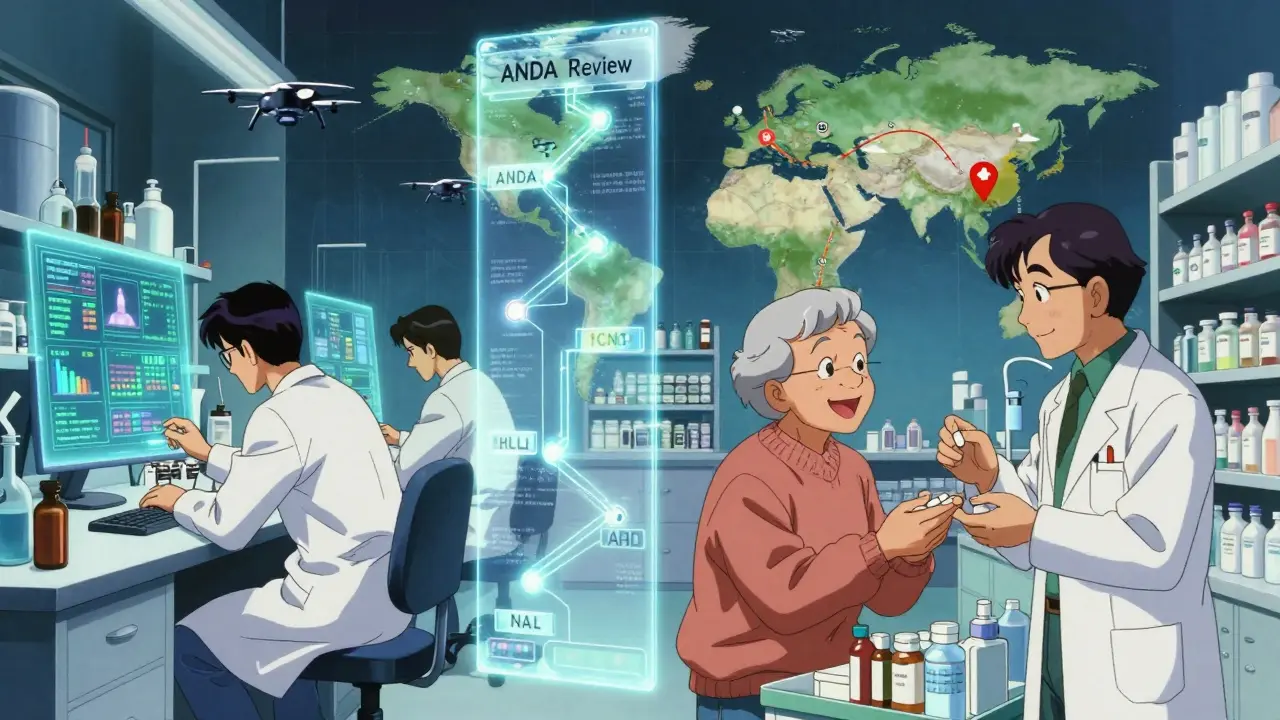
The OGD’s core job is simple: get high-quality generic drugs to patients as quickly and safely as possible. It reviews and approves Abbreviated New Drug Applications (ANDAs), which are the formal requests from manufacturers to sell generic versions of brand-name drugs. But behind that simple sentence is a complex system of science, regulation, and logistics.
Every ANDA must prove the generic drug is bioequivalent to the brand-name drug. That means it delivers the same amount of active ingredient into the bloodstream at the same rate. The OGD doesn’t just accept claims-it tests them. Its Office of Bioequivalence runs labs, analyzes data, and sets the standards for what counts as "the same" in real-world use.
It also handles patent and exclusivity issues under the Hatch-Waxman Act. If a brand-name company holds a patent, the OGD must determine whether a generic can enter the market before that patent expires. It tracks exclusivity periods, reviews certifications, and makes decisions that can delay or accelerate generic competition. These decisions affect not just companies, but millions of patients waiting for affordable options.
How OGD Is Structured to Get the Job Done
In 2013, the FDA reorganized the Office of Generic Drugs into a "super office"-a move that gave it direct reporting to the head of the Center for Drug Evaluation and Research (CDER). This wasn’t just a name change. It was a power upgrade. The goal? To cut through bureaucracy and speed up approvals without sacrificing safety.
OGD is now made up of six main units:
- Immediate Office (IO): The nerve center. It sets strategy, manages budgets, coordinates global efforts, and handles legal and policy questions. This is where the big decisions are made.
- Office of Bioequivalence (OB): The science team. It determines how to prove a generic drug works like the brand. It includes the OGD Safety and Surveillance Team, which watches for unexpected side effects after generics hit the market.
- Office of Generic Drug Policy: The rulebook writers. This group interprets the Hatch-Waxman Act and creates guidance for manufacturers. They answer questions like: "Can we use a different salt form?" or "Does this change count as a new product?"
- Office of Regulatory Operations (ORO): The project managers. This team assigns reviewers to each ANDA, tracks deadlines, and makes sure every application meets GDUFA timelines. They’re the ones holding people accountable for getting reviews done on time.
- Office of Research and Standards (ORS): The innovators. They develop new testing methods, use modeling to predict how drugs behave, and push the science forward. If a drug is hard to test with old methods, ORS finds a new way.
- Office of Safety and Clinical Evaluation: The watchdogs. They review clinical data, assess risks, and work with other FDA offices to ensure safety labels and Risk Evaluation and Mitigation Strategies (REMS) are consistent across brand and generic versions.
Each unit has its own specialists-pharmacists, physicians, chemists, statisticians, and lawyers-all working in sync. No single person or team owns the entire process. But the Immediate Office makes sure everything stays aligned.
The Rules That Keep Generic Drugs Honest
OGD doesn’t work in a vacuum. Two laws shape everything it does: the Hatch-Waxman Act and GDUFA.
The Hatch-Waxman Act of 1984 created the modern generic drug system. Before this law, companies had to repeat the full clinical trials of brand-name drugs to get approval-costing millions and taking years. Hatch-Waxman let them prove bioequivalence instead, slashing costs and time. But it also gave brand-name companies patent extensions and market exclusivity to balance innovation and competition. OGD’s Division of Legal and Regulatory Support is the agency’s expert on this law. They know every clause, every exception, every loophole.
GDUFA-the Generic Drug User Fee Amendments-is what keeps the wheels turning. Since 2012, generic drug makers pay fees to the FDA to fund the review process. These aren’t taxes. They’re user fees tied to performance. If OGD misses its review deadlines, it doesn’t get paid. If it approves a drug too fast and something goes wrong, it loses trust. This system created accountability. In 2022, OGD met 95% of its GDUFA review goals for priority ANDAs.
OGD also works with international regulators. Through its Global Generic Drug Affairs Team, it coordinates with agencies in Europe, Canada, Japan, and beyond. Why? Because many generic drugs are made overseas. OGD inspects foreign factories, shares data, and aligns standards so a pill made in India meets U.S. safety rules.
How OGD Handles Drug Shortages and Public Health Crises
When a critical drug runs out-like insulin, antibiotics, or cancer treatments-the OGD doesn’t wait for someone to ask for help. It actively tracks shortages and fast-tracks applications for generics that can fill the gap.
For example, if a brand-name drug is in short supply and there’s a generic waiting in the pipeline, OGD can give it priority review. It also works with manufacturers to resolve manufacturing issues before they become shortages. A small problem with a filler ingredient or packaging line can be fixed early if OGD flags it during review.
During the COVID-19 pandemic, OGD reviewed dozens of emergency generic applications for drugs used in ICU settings. It didn’t lower standards-it just moved faster. That’s the difference between a bureaucratic agency and one that understands its mission.
Why Generic Drugs Are Not "Cheap Copies"
There’s a myth that generic drugs are inferior. They’re not. OGD requires that generics have the same active ingredient, strength, dosage form, and route of administration as the brand. They must be bioequivalent. They must be manufactured under the same strict quality controls.
Some generics even have better quality. Many are made in the same factories as brand-name drugs. The only difference? The label. The price. And sometimes, the patient’s out-of-pocket cost drops from $300 to $10.
OGD’s job is to prove that difference doesn’t matter. And it does-every day, for millions of Americans.
Who Decides When a Generic Can Launch?
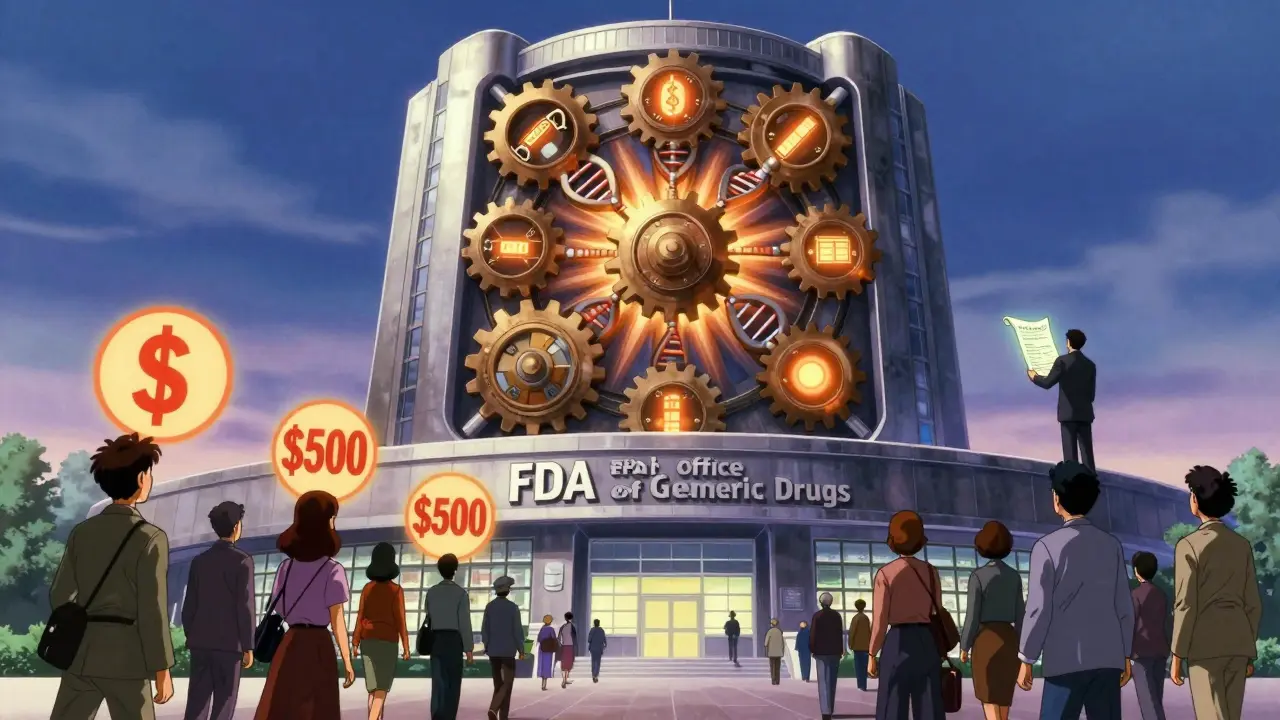
It’s not just OGD. It’s a chain of decisions. A manufacturer files an ANDA. OGD reviews it. If it’s the first generic, OGD checks if the brand has exclusivity. If the patent is still active, OGD reviews the patent certification. If the generic claims the patent is invalid or won’t be infringed, the brand can sue-and that delays approval for 30 months.
OGD doesn’t make the legal call. But it tracks every filing, every court case, every exclusivity period. It tells the manufacturer: "You’re eligible to launch on this date." That’s the moment when a drug goes from approved to available. And OGD makes sure that moment happens on time.
What Happens After Approval?
Approval isn’t the end. OGD keeps watching. Its Safety and Surveillance Team monitors adverse event reports. If a generic drug causes more side effects than expected, OGD investigates. It may require label changes, issue safety alerts, or even pull the product.
It also inspects manufacturing sites-both in the U.S. and abroad. One inspection can shut down a whole supply chain. OGD doesn’t wait for complaints. It proactively checks plants, especially those with a history of violations.
This ongoing oversight is why generic drugs have the same safety record as brand-name drugs. It’s not luck. It’s a system built by OGD.
How OGD Impacts You
If you’ve ever chosen a generic drug because it was cheaper, you’ve benefited from OGD’s work. If you’ve filled a prescription for a chronic condition and didn’t have to skip doses because of cost-you’ve seen its impact.
OGD doesn’t just save money. It saves lives. In 2023, Americans saved over $350 billion by using generic drugs. That’s more than the entire budget of the Department of Education. And nearly all of that savings came because OGD approved those drugs efficiently, fairly, and safely.
It’s not glamorous work. No one throws parades for the team that approved 127 ANDAs last month. But every time you walk out of the pharmacy with a $5 prescription instead of a $500 one, you’re holding a piece of their success.

15 Comments
Pooja Kumari
Jan 7 2026I remember when my mom couldn’t afford her blood pressure med and had to split pills in half just to make it last. Then one day the pharmacist handed her this little white pill labeled 'lisinopril' for $4 and she cried. I didn’t even know what OGD was back then, but now I know it’s the reason she’s still here. This isn’t bureaucracy-it’s lifelines in pill form. I’m Indian, and I’ve seen how generic drugs from here save lives back home too. The FDA doesn’t get enough credit for this quiet, massive work.
Jacob Paterson
Jan 8 2026Oh wow. A 12-page essay on how the FDA doesn’t suck. Groundbreaking. Next you’ll tell me water is wet and oxygen keeps us alive. Meanwhile, my cousin’s generic metformin gave him stomach cramps so bad he ended up in the ER. Guess what? The label didn’t warn him. But hey, bioequivalent, right? Science. 😌
Angela Stanton
Jan 8 2026Let’s break this down: GDUFA = performance-based funding → incentivizes throughput → BUT → safety surveillance is under-resourced relative to volume. OB’s lab capacity hasn’t scaled linearly with ANDA submissions since 2018. ORS is doing cool stuff with PBPK modeling, but 60% of inspections are still risk-based, not data-driven. And don’t get me started on the 30-month stay loophole being weaponized by pharma giants. We’re gaming the system, not fixing it. 📊
Johanna Baxter
Jan 8 2026This whole thing is a joke. My cousin got a generic version of his antidepressant and felt like a zombie for 3 weeks. They call it bioequivalent but it’s not the same. People are dying because some bean counter in DC decided to cut corners. I’m so done with this system.
Jerian Lewis
Jan 9 2026It’s strange how people romanticize the OGD. It’s just a government office doing a job. The real heroes are the chemists in India and China who actually make the pills under conditions most Americans wouldn’t tolerate. The FDA doesn’t create access-it just rubber-stamps it. We should be building our own domestic supply chains, not outsourcing our health to overseas factories.
Kiruthiga Udayakumar
Jan 10 2026As someone from India who’s seen how Indian generics save lives in Africa and Southeast Asia, I’m proud of what OGD does. But let’s be real-why do we trust a pill made in a factory that got flagged for violations 3 years ago? OGD needs more teeth. Not more meetings. More inspections. More transparency. My uncle died because his generic diabetes med was contaminated. Don’t tell me it’s ‘bioequivalent’ when the excipients are trash.
Patty Walters
Jan 11 2026Just wanted to say thank you to the OGD team. I’ve been on the same generic cholesterol med for 8 years and never had an issue. I’m not a scientist, but I know when something works. Also, the FDA’s website has a great tool to check if your generic is approved-look up the ‘Orange Book’. It’s under ‘Drugs@FDA’. Super easy. 🙏
Phil Kemling
Jan 12 2026What does ‘equivalent’ even mean? If two drugs have the same active ingredient but different fillers, binders, and coatings-do they behave the same in a human body under stress, under sleep deprivation, under chronic inflammation? The science assumes homogeneity, but biology is messy. OGD optimizes for regulatory efficiency, not biological nuance. We treat medicine like software updates. It’s not. We’re not coding. We’re healing.
tali murah
Jan 13 2026Let’s be honest: the entire generic drug system is a corporate shell game. The same companies that make brand-name drugs own the generics. The same factories. The same executives. OGD is just the polite middleman letting them profit twice. And we’re supposed to cheer because it’s ‘cheaper’? No. It’s the same monopoly with a different label. Wake up.
Diana Stoyanova
Jan 14 2026Y’all don’t realize how wild this is. Every single time you take a $5 pill instead of a $500 one, you’re part of a global revolution. This isn’t just about money-it’s about dignity. People choose between food and meds every day. OGD is the quiet force that says ‘no, you don’t have to choose.’ I’ve seen kids in rural Tennessee get their asthma inhalers because of this office. That’s not bureaucracy. That’s love in a white pill. 🌟
Jenci Spradlin
Jan 14 2026forgot to mention-OGD also checks if the generic’s packaging is tamper-proof. That’s huge. I had a friend who got a bottle of generic benadryl and the cap was loose. turned out it was from a factory that skipped QC. OGD flagged it and pulled the whole batch. Small thing, but it matters. also, ‘bioequivalent’ doesn’t mean ‘identical’-it means ‘same effect’. kinda like two different chefs making the same dish. same taste, different spices.
Elisha Muwanga
Jan 14 2026Why are we letting foreign factories make our life-saving drugs? This is national security. China and India control 80% of the API supply. We’re dependent on regimes that don’t share our values. OGD is just a band-aid on a bullet wound. We need to bring manufacturing back to America. Or at least Canada. Not India. Not China. This isn’t a cost-cutting exercise-it’s a betrayal.
Maggie Noe
Jan 16 2026There’s something beautiful about how this works. A guy in New Jersey files an ANDA. A chemist in Hyderabad runs tests. A reviewer in Silver Spring checks the data. A pharmacist in Alabama dispenses it. And a grandma in Ohio takes it without knowing any of that. No fanfare. No headlines. Just silent, steady, science-backed care. That’s the American dream. Not the loud kind. The quiet kind.
Gregory Clayton
Jan 17 2026They’re lying to you. Generic drugs are not the same. I’ve been on 3 different generics for my thyroid med and each one made me feel different. One made me shaky. One made me sleepy. One made me cry for no reason. The FDA says ‘bioequivalent’ but your body knows the truth. They don’t test for how you FEEL. They test for numbers on a graph. That’s not medicine. That’s math.
Catherine Scutt
Jan 19 2026Ugh. Another one of these posts. Like we need a textbook on how the FDA does its job. Can we just agree that generics are cheaper and move on? No one cares about GDUFA timelines or ORS modeling. I just want my pills to work without paying $200. End of story.