Storing insulin properly isn’t just a suggestion-it’s a matter of life and death. If your insulin loses potency, your blood sugar can swing dangerously high or low without warning. You might not even realize it’s happening until you’re in trouble. And the worst part? Most people get it wrong.
Insulin is a protein. That means it’s fragile. Heat, cold, light, and even shaking can break it down. Once that happens, it doesn’t work the way it should. You could be injecting something that’s 30% weaker and never know it. That’s why knowing exactly where to keep your insulin-whether it’s a pen, a vial, or a pump-isn’t optional. It’s essential.
Unopened Insulin: Keep It Cold
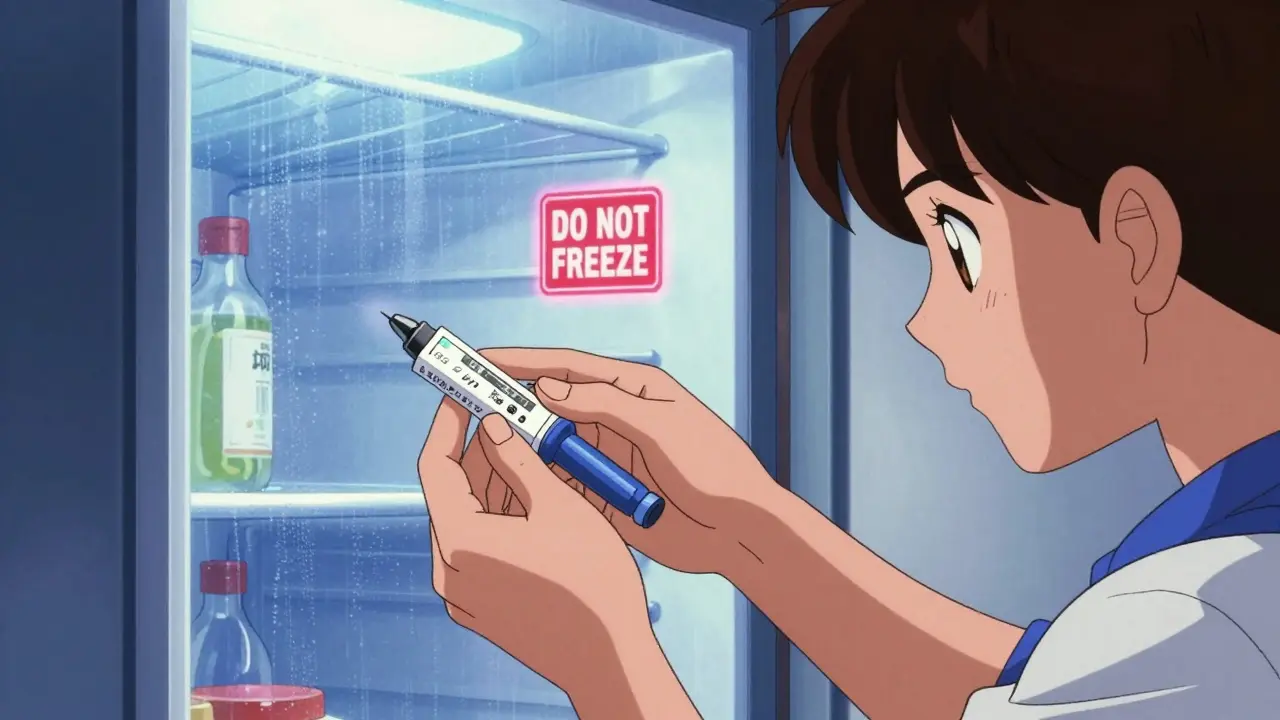
Before you open a new insulin vial or pen, it needs to stay refrigerated. The sweet spot is between 36°F and 46°F (2°C to 8°C). That’s your fridge’s main compartment, not the door, not the freezer drawer, and definitely not on top of the fridge where it gets warm. Many home fridges have spots that dip below freezing, especially near the back wall. If insulin freezes, it forms crystals inside. Once that happens, it’s ruined. No amount of warming up will fix it. You’ll need a new one.
Check the expiration date on the box. Even if it’s stored perfectly, insulin doesn’t last forever. Unopened vials and pens should be used before that date. But don’t just trust the label. If the insulin looks cloudy, clumpy, or discolored-even if it’s before the expiration date-throw it out. Clear insulin should stay clear. If it doesn’t, something’s wrong.
Opened Insulin: Room Temperature Is Fine-For a While
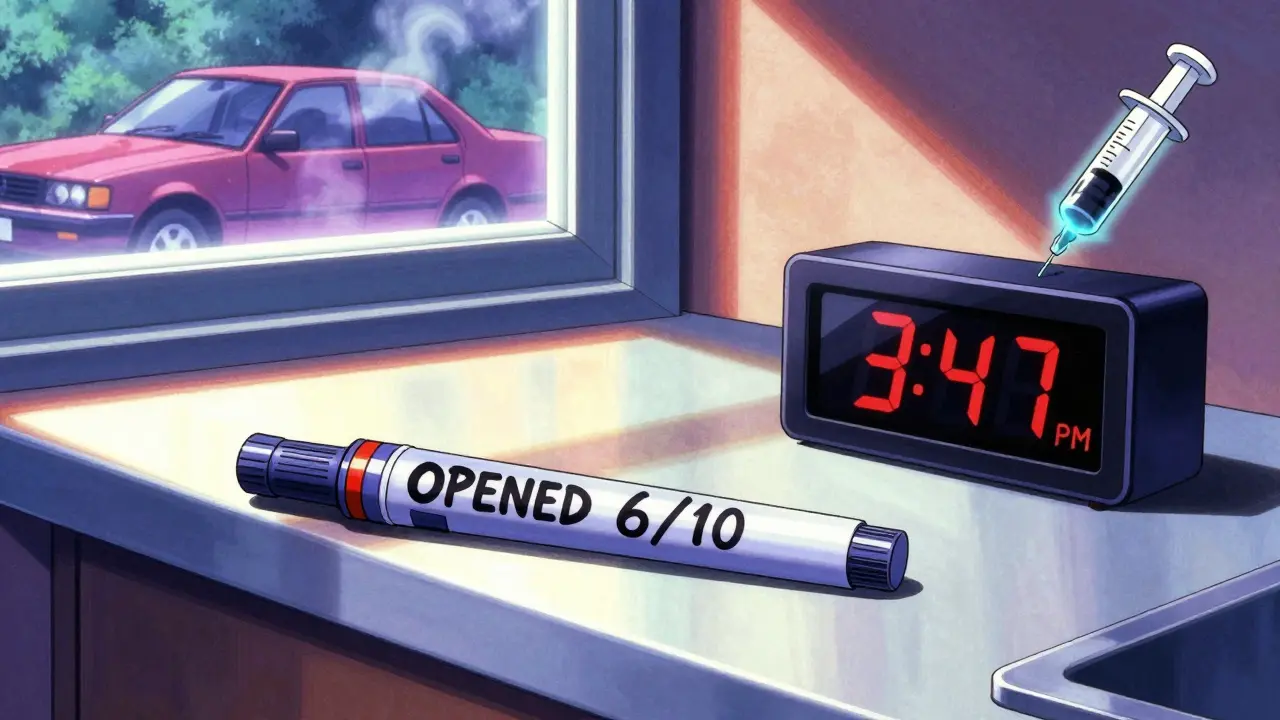
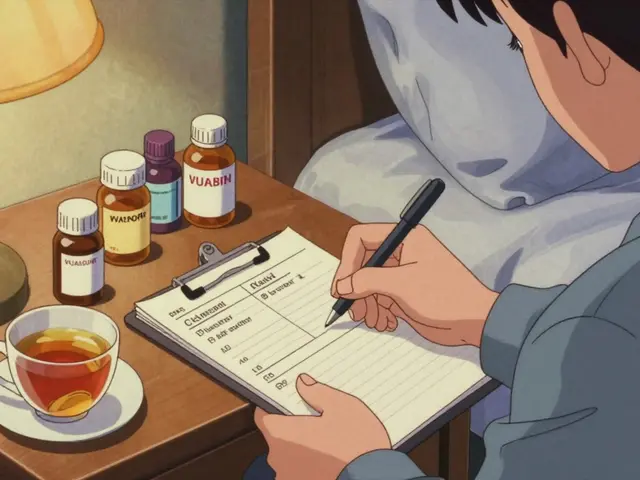
Once you start using insulin, you don’t need to keep it cold. In fact, injecting cold insulin hurts. Most people prefer it at room temperature. The good news? Most insulin can safely sit out at room temperature-between 59°F and 86°F (15°C to 30°C)-for up to 28 days. That’s the rule for most pens and vials: once you prick the cap or start using it, mark the date with a permanent marker. Then, use it within four weeks.
But not all insulins follow the same rules.
- Isophane (NPH) expires after 14 days at room temperature.
- Insulin Degludec (Tresiba) lasts a full 8 weeks once opened.
- Insulin Glargine U300 (Toujeo) was approved in early 2023 for 56 days at room temperature.
Check the package insert that came with your insulin. If you lost it, look up the brand name online. Manufacturer guidelines vary, and assuming all insulin is the same can lead to mistakes. And don’t forget: if the room gets hotter than 86°F, even for a few hours, it’s time to toss it. A car on a sunny day? That’s not a storage option. Interior temperatures can hit 120°F in minutes. That’s not just warm-that’s destructive.
Insulin Pumps: Shorter Lifespan, Higher Risk
If you use an insulin pump, your rules change. Once insulin is drawn into the pump reservoir, it’s exposed to air and movement. Even if it’s kept cool, it shouldn’t stay in the pump longer than 72 hours. After that, even if it looks fine, it’s time to change it. Why? Because bacteria can grow, and the insulin can break down faster in the tubing.
Also, if insulin is removed from its original vial and loaded into a pump, it must be discarded after 14 days-even if it’s still within the 28-day window. That’s because once it’s outside the sealed container, it’s more vulnerable to contamination and degradation.
And if your pump gets too hot? If the temperature goes above 98.6°F (37°C), throw it out immediately. No exceptions. The FDA says insulin in pumps degrades faster than in pens or vials. You can’t risk it.
What to Avoid at All Costs
Here are the top five storage mistakes people make-and why they’re dangerous:
- Leaving insulin in the car. Even on a mild 75°F day, the inside of a car can hit 110°F. That’s enough to ruin insulin in under an hour.
- Storing it in the fridge door. Every time you open the door, the temperature swings. That’s enough to shorten its shelf life.
- Using insulin past its 28-day limit. 63% of users admit they’ve done this. 28% say they noticed worse blood sugar control afterward.
- Not marking the opening date. A University of Michigan study found that people who marked their insulin reduced expired use by 68%.
- Keeping it near a window or heater. Sunlight and heat break down insulin faster. Store it in a cool, dark place.
One user on Reddit, ‘Type1Engineer,’ lost $380 worth of insulin after their fridge broke and hit 50°F for 48 hours. Their blood sugar went wild. They didn’t realize the problem until their insulin stopped working. That’s the kind of thing you can’t afford to learn the hard way.
Traveling with Insulin: Keep It Safe
Traveling? You need a plan. Don’t rely on hotel fridges-they can be too warm or too cold. Don’t check insulin in luggage. Baggage holds can drop below freezing or spike over 100°F.
Use an insulated cooler designed for insulin. Products like the Frio Wallet use evaporative cooling and maintain safe temperatures for up to 45 hours without ice. They’re lightweight, reusable, and fit easily in a purse or backpack. Other options include gel packs that stay cool for 48 hours. These cost $25 to $50, but they’re cheaper than replacing spoiled insulin.
Always carry a backup. Bring extra pens or vials, and keep them in a separate cooler. If one fails, you’ve got a spare. And never fly without your insulin in your carry-on. TSA lets you bring it through security with no hassle-you just need to declare it.

What About Expired or Used Insulin?
Never use insulin past its expiration date, even if it looks fine. And never flush it down the toilet or toss it in the trash. That’s unsafe for the environment and for others.
Most pharmacies have take-back programs. Ask your pharmacist. Some local health departments run disposal events. In New Zealand, you can return used insulin to a pharmacy for safe disposal. If you’re unsure, call your local pharmacy. They’ll tell you how to do it right.
For used needles and syringes, use a sharps container. If you don’t have one, a sturdy plastic bottle with a tight lid works-like a laundry detergent bottle. Label it clearly: “Sharps-Do Not Recycle.” Seal it when full and dispose of it through your local medical waste program.
Real Numbers, Real Consequences
Here’s what the data says:
- 17% of unexplained blood sugar swings in insulin users are linked to improperly stored insulin (American Diabetes Association, 2022).
- Over $1.2 billion is wasted annually in the U.S. alone due to spoiled insulin (ADA Economic Costs Report, 2023).
- 8.2% of summer emergency room admissions for diabetic ketoacidosis were tied to degraded insulin (IDF Europe, 2019).
These aren’t abstract numbers. They’re people. They’re you. They’re your loved ones.
The good news? You can avoid all of this. Just mark the date. Keep it cool, but not frozen. Don’t leave it in the sun. And when in doubt-throw it out.
Insulin doesn’t need to be perfect. But it does need to be handled with care. One small habit-writing the date on the pen-can save you from chaos. One smart choice-carrying a cooler-can keep you safe on the road. Don’t wait until something goes wrong. Start today.
Can I keep insulin in the fridge after I start using it?
You can, but it’s not necessary. Once opened, insulin is stable at room temperature (59°F to 86°F) for up to 28 days for most types. Refrigerating it after opening doesn’t extend its life-it just makes injections uncomfortable. Letting it warm to room temperature for 30 minutes before injecting reduces pain and improves comfort.
What if my insulin was left in a hot car for a few hours?
If the temperature inside the car exceeded 86°F, throw it out. Even if it looks normal, heat damages insulin at a molecular level. The FDA says insulin loses 1.3% of its potency per hour at 86°F and degrades completely within 48 hours at 104°F. You can’t tell by looking-it’s invisible damage. Better safe than sorry.
Does insulin expire faster in hot climates?
Yes. In places where temperatures regularly climb above 86°F, insulin breaks down faster. If you live in a hot area, store your opened insulin in a cool, dark place-even if it’s not refrigerated. Use insulated bags when outdoors. Some newer insulins, like Toujeo, are designed to last longer in heat, but always check the label for your specific brand.
Can I reuse insulin pens or vials after their expiration date?
No. Expired insulin may look fine, but its chemical structure changes over time. Using it can lead to unpredictable blood sugar levels, increasing the risk of hypoglycemia or hyperglycemia. Never use insulin past its labeled expiration date, even if it’s been refrigerated.
How do I know if my insulin has gone bad?
Look for changes in appearance. Clear insulin should be clear. If it’s cloudy, clumpy, or has particles floating in it, discard it. Also, if you notice unexplained high blood sugars or more frequent highs and lows, degraded insulin could be the cause. Always check the date you opened it. If it’s past the 28-day window (or shorter, for some types), replace it.





14 Comments
RacRac Rachel
Mar 5 2026Just started using insulin last year and this post saved me so much stress. 🙌 I used to keep my pen in the fridge door until I read this-now I mark the date with a sharpie and keep it in the main compartment. No more unexplained highs! Also, I got a Frio wallet for travel and it’s a game-changer. Seriously, if you’re reading this and haven’t marked your insulin yet-do it today. Your future self will thank you. 💪
Chris Beckman
Mar 5 2026you guys are overthinking this. i just keep it in my glovebox. its fine. i mean, how many people actually die from bad insulin? its not like its rocket science. 28 days? pfft. ive had the same pen for 4 months. no issues. if it looks clear and doesnt leak, its good. stop scaring people.
Richard Elric5111
Mar 7 2026It is, in essence, a profound metaphysical paradox: the preservation of a life-sustaining protein, subjected to the capricious whims of thermodynamic entropy, yet demanded to retain its biological integrity under conditions of human negligence. The insulin vial, once opened, becomes a temporal artifact-its efficacy measured not in molecular bonds alone, but in the discipline of the caretaker. To disregard the 28-day window is not merely imprudent-it is an ontological failure of stewardship. One does not treat the divine with casual indifference, and insulin, in its quiet, life-giving function, demands reverence.
Dean Jones
Mar 9 2026Let me tell you something nobody else is saying. The real issue isn’t just storage-it’s the entire system. Why are we expected to remember dates? Why isn’t there a smart pen that auto-logs activation? Why does the FDA allow manufacturers to set different expiration windows without standardization? And why is the only solution ‘throw it out’ instead of testing kits? I’ve lost three pens in the last year because I forgot the date. I’m not lazy-I’m overwhelmed. The system is designed for perfect users, not real people with jobs, kids, and sleep deprivation. We need tech, not reminders. We need accountability from the industry, not guilt trips. This isn’t about discipline. It’s about design failure.
Betsy Silverman
Mar 10 2026I’m from a rural town in Texas and we don’t always have reliable fridges. I use an insulated pouch with a cold pack and it works wonders. Also, I tell every new diabetic I meet about marking the date-it’s such a simple thing but so few do it. I keep a little notebook in my purse with the dates. It’s like a little ritual now. You’re not alone in this. We’re all figuring it out together.
Ivan Viktor
Mar 11 2026So let me get this straight. You’re telling me I can’t leave my insulin in the car because it might get hot… but I can leave it in a 100-degree house for 12 hours? Cool. And I’m supposed to pay $50 for a ‘Frio Wallet’ when I could just… not go to the beach? Maybe if people stopped treating insulin like a sacred relic and just used common sense, we’d all be fine. Also, I’ve never had a problem with expired insulin. Just saying.
Jeff Card
Mar 11 2026My sister had a fridge failure last summer. Her insulin was at 50°F for two days. She didn’t know until her BG spiked to 420. She ended up in the ER. This post? It’s not just info-it’s a lifeline. I’ve shared it with three people already. If you’re reading this and you’re a caregiver, a friend, or someone who’s ever said ‘it’s probably fine’-please, take five minutes and read this again. Someone’s life might depend on it.
marjorie arsenault
Mar 11 2026You got this. Seriously. One small step at a time. Mark the date. Use a cooler. Keep backups. You don’t have to be perfect-just consistent. And if you slip up? That’s okay. Just reset and keep going. You’re not alone. We’re all here rooting for you.
Deborah Dennis
Mar 12 2026I can't believe people still do this. Seriously? Leaving insulin in the car? Marking dates? Are you kidding me? This is basic. Basic. If you can't handle this, maybe you shouldn't be managing your own diabetes. I've been doing this for 20 years. I don't need a guide. I need people to stop being careless.
Shivam Pawa
Mar 13 2026Insulin degradation is a kinetic process governed by Arrhenius equation. Elevated temperature increases molecular vibration, leading to conformational instability. In tropical climates, ambient heat accelerates this exponentially. Hence, thermal shielding is non-negotiable. Use phase-change materials. Avoid plastic containers. Aluminum foil + insulated pouch is cost-effective. Also, check manufacturer stability data-some insulins like degludec have activation energy thresholds below 30°C. Knowledge is power.
Diane Croft
Mar 13 2026Just got my first insulin pen. This post is everything. I’m printing it out and taping it to my fridge. Thank you for writing this. No one talks about how scary it is to start. You made it feel manageable. I’m gonna buy a Frio wallet this weekend. Small steps.
Donna Zurick
Mar 15 2026My mom used to keep her insulin in the freezer because she thought cold = better. We lost three vials before I figured it out. Now I keep a little card in her wallet: ‘Room temp. 28 days. No freezing.’ She says it’s the best gift I ever gave her. You don’t need to be a scientist. Just be consistent.
Tobias Mösl
Mar 17 2026Let’s be real. The pharmaceutical companies make billions off this. They design insulin to degrade quickly. Why? So you keep buying. They don’t want smart pens. They don’t want standardized expiration dates. They want you scared. They want you confused. They want you to think it’s your fault. It’s not. It’s corporate greed. The FDA? In bed with Big Pharma. That’s why you can’t trust the labels. That’s why you need to test your insulin with a glucose meter-because they’re lying to you. And if you’re still using insulin past 28 days? You’re being played.
tatiana verdesoto
Mar 17 2026I love how this post includes the data. It’s not just advice-it’s evidence. I showed this to my diabetes group last week. We all started marking our pens. One woman said she hadn’t checked her insulin in two years. She cried. We hugged. That’s what this is about. Not just storage. Connection. Care. We’re not just managing a disease. We’re protecting each other.