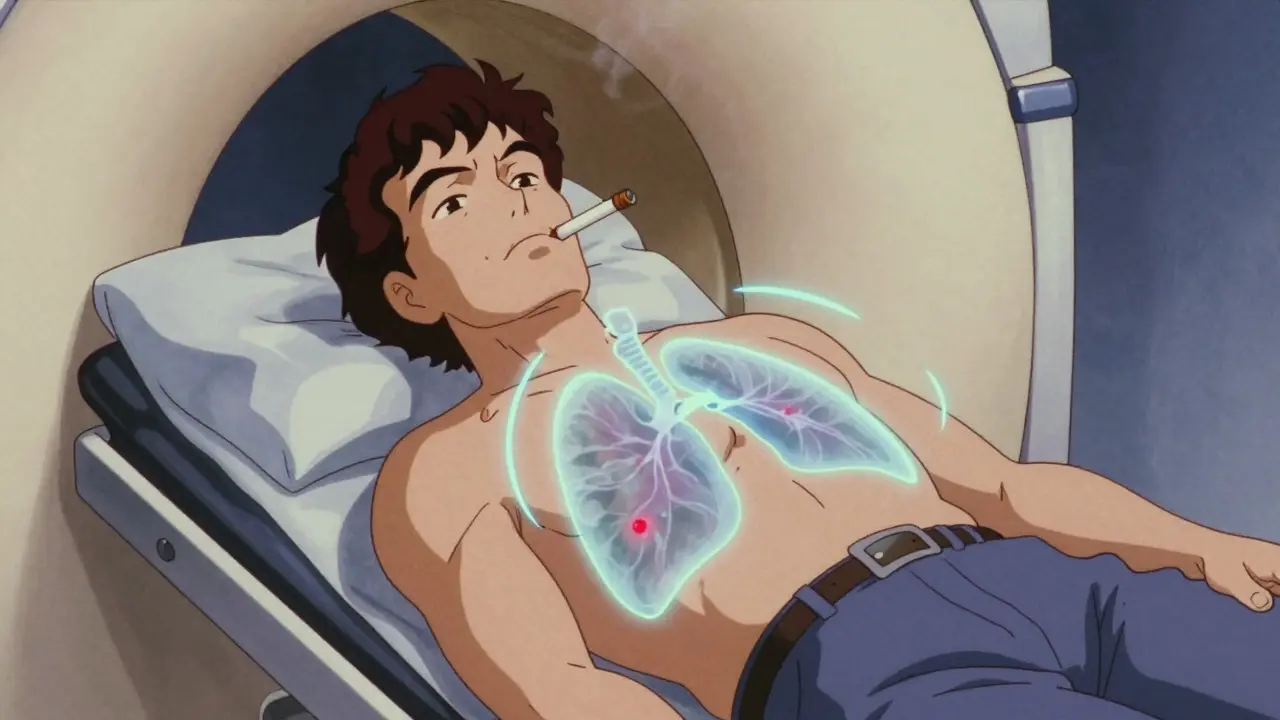
Every year, over 120,000 people in the U.S. die from lung cancer. That’s more than colon, breast, and prostate cancers combined. Yet, most of these deaths are preventable-if we catch it early. For smokers and former smokers, lung cancer screening isn’t just an option anymore-it’s a lifeline. And when combined with advances in targeted therapy, the chances of survival are no longer slim.
Who Should Be Screened? The Rules Have Changed
If you smoked a pack a day for 20 years-or two packs a day for 10 years-you’re in the high-risk group. That’s called a 20 pack-year history. It doesn’t matter if you quit five years ago or 20 years ago. The old rule-only screen people who quit within the last 15 years-is gone. In March 2023, the American Cancer Society updated its guidelines to remove that cutoff. Why? Because research shows former smokers remain at high risk for decades.A 2022 study in JAMA Oncology found people who quit smoking 15 to 30 years ago still had 2.5 times the risk of lung cancer compared to people who never smoked. That’s why screening now starts at age 50, not 55. And it continues until age 80, as long as you’re healthy enough to handle treatment.
But here’s the problem: only 18% of eligible people are getting screened. In 2021, about 14.5 million Americans qualified under the latest guidelines. Only 2.6 million got a scan. Why? Many doctors don’t know the rules. Insurance plans still use outdated criteria. And rural areas? They have 67% fewer screening centers than cities.
What Happens During a Lung Cancer Screening?
The test is simple: a low-dose CT scan, or LDCT. It’s not like a regular chest X-ray. This scan uses 70-80% less radiation than a standard CT. You lie on a table, breathe in, hold it for a few seconds, and it’s over. No needles. No fasting. No prep.The scan looks for tiny nodules-small spots on the lungs. Most are harmless. In fact, the National Lung Screening Trial found that 96.4% of positive scans turned out to be false alarms. That’s why follow-up is critical. Not every nodule needs surgery. Some are monitored with repeat scans. Others get biopsies. The key is having a structured program with experienced radiologists and pulmonologists.
Accredited centers follow strict protocols: 120 kVp, 30-50 mAs, slice thickness of 1.25-2.5 mm. These settings ensure the image is clear enough to catch early tumors but keeps radiation low. The American College of Radiology only accredits about 2,800 facilities nationwide. If your doctor refers you for screening, ask if they’re accredited. If not, push for a referral to one that is.
Why Early Detection Matters
Lung cancer caught in its earliest stage has a 59% five-year survival rate. That’s a huge jump from the 6% survival rate when it’s found late-after it’s spread to other organs. But only 23% of cases are caught early. That’s because most people don’t have symptoms until it’s advanced.Screening catches tumors before they cause coughing, weight loss, or shortness of breath. And here’s the kicker: when a tumor is found early, surgery is often enough. No chemo. No radiation. Just removing the tumor, and you’re done. That’s why screening saves lives. A 2021 study in the New England Journal of Medicine showed annual LDCT scans reduced lung cancer deaths by 20% over 6 years.
But screening only works if you’re healthy enough to treat what’s found. If you have severe heart disease, advanced COPD, or other conditions that limit life expectancy, screening might not help. That’s why doctors do a shared decision-making visit before the scan. They talk about risks, benefits, and your goals. It’s not just about finding cancer-it’s about whether finding it will change your outcome.
Targeted Therapy: When Cancer Has a Genetic Signature
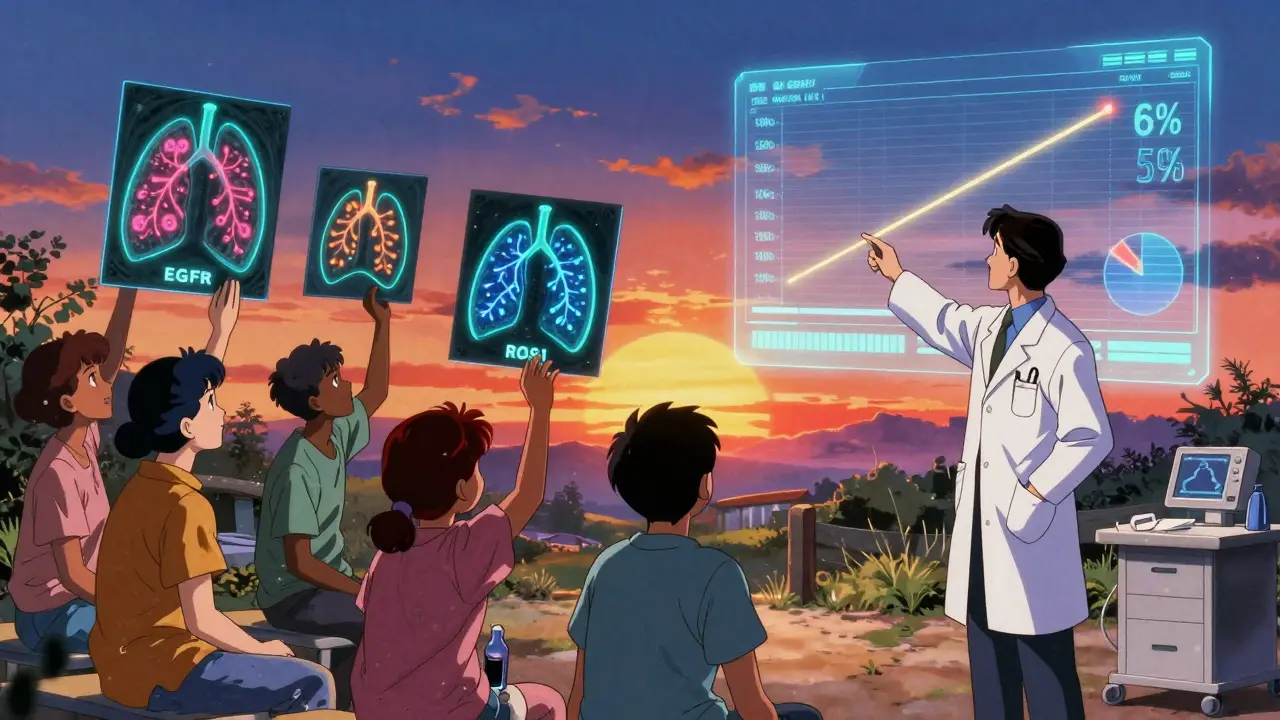
Not all lung cancers are the same. About 15-30% of non-small cell lung cancers (the most common type) have specific gene mutations. These mutations act like a fingerprint. And now, we have drugs designed to target them.Take EGFR mutations. They’re found in about 10-15% of lung cancers in the U.S., more common in non-smokers and women. The drug osimertinib (brand name Tagrisso) was approved in 2020 as an adjuvant treatment-meaning after surgery-for early-stage patients with EGFR mutations. The ADAURA trial showed it cut the risk of cancer returning by 83%. That’s not just a number. That’s a chance to live years longer without treatment.
ALK, ROS1, MET, RET, NTRK-these are other mutations with targeted drugs. And here’s the big shift: we’re finding more of them in early-stage cancers thanks to screening. The International Association for the Study of Lung Cancer predicts that by 2025, 70% of early-stage lung cancers found through screening will have a targetable mutation. In late-stage cases? Only 30% do.
That’s because tumors caught early are genetically simpler. They haven’t evolved multiple resistance mechanisms yet. That means targeted drugs work better. And they have fewer side effects than chemo. No hair loss. No severe nausea. Just a daily pill.
What’s Next? AI, Liquid Biopsies, and Personalized Screening
The next wave of lung cancer care is smarter, not just faster. AI tools like LungQ by Riverain Technologies-approved by the FDA in January 2023-help radiologists spot nodules faster and reduce false positives by 22%. That means fewer unnecessary biopsies and less anxiety.And then there’s liquid biopsy. Instead of waiting for a tumor to show up on a scan, we’re starting to test blood for tumor DNA. If we can detect cancer-related mutations in the bloodstream before a tumor is visible, we could screen even earlier. Trials like NCT04541082 and NCT04924022 are testing this right now. The goal? To combine blood tests with LDCT scans to catch cancer before it even forms a visible nodule.
The PACIFIC trial, launching in mid-2024, will follow 10,000 people to see if adding genetic risk scores and environmental exposure data (like radon or air pollution) can make screening more precise. Right now, we screen based on smoking history. In five years, we might screen based on your unique risk profile.

Barriers to Getting Screened
Even with all the advances, many people still don’t get screened. Here’s why:- Doctors don’t ask. A 2022 survey found only 58% of family doctors routinely talk about lung cancer screening with eligible patients.
- Insurance confusion. Medicare covers screening for ages 50-77 with 20+ pack-years. But some private insurers still require 30 pack-years and age 55+. You may need to push.
- Access gaps. Rural communities have far fewer screening centers. Black patients are 35% less likely to be screened than white patients. These disparities aren’t random-they’re systemic.
- Stigma. Some people feel guilty about smoking. They think screening is punishment. But screening isn’t about blame. It’s about survival.
Successful programs use electronic health record alerts, patient navigators, and integrated smoking cessation support. One study showed EHR prompts increased screening rates by 32%. Patient navigators improved adherence by 27%. And 70% of current smokers in screening programs say they want to quit-yet only 30% get help. That’s a missed opportunity.
What You Can Do
If you’re a current or former smoker:- Calculate your pack-years. Multiply the number of packs per day by the number of years you smoked.
- Ask your doctor if you qualify for screening. Don’t wait for them to bring it up.
- If you’re still smoking, ask for help quitting. Screening works best when paired with cessation.
- Find an accredited center. Ask if they’re ACR-accredited and if they use AI-assisted analysis.
- Keep your scan annual. Missing one year cuts the benefit.
If you’re a former smoker who quit more than 15 years ago, you still need screening. Your risk didn’t disappear. It just got quieter.
Lung cancer isn’t a death sentence anymore-not if we catch it early and treat it smartly. Screening finds it. Targeted therapy stops it from coming back. Together, they’re changing the story.
Who qualifies for lung cancer screening?
You qualify if you’re between 50 and 80 years old, have a 20+ pack-year smoking history, and currently smoke or quit within the past 15 years (per USPSTF). The American Cancer Society removed the 15-year quit limit in 2023, meaning even those who quit decades ago may still benefit. You must also be healthy enough to undergo treatment if cancer is found.
Is a low-dose CT scan safe?
Yes. A low-dose CT (LDCT) uses 70-80% less radiation than a standard CT scan-about the same as a mammogram. The benefit of catching early cancer far outweighs the small radiation risk. Annual screening is considered safe for eligible individuals. Facilities follow strict protocols (120 kVp, 30-50 mAs) to minimize exposure.
What if the scan finds a nodule?
Most nodules (over 96%) are not cancer. Follow-up depends on size, shape, and growth. Small nodules may be checked again in 3-6 months. Larger or suspicious ones may require a biopsy or PET scan. A structured program with a multidisciplinary team ensures you don’t get unnecessary procedures.
Can targeted therapy cure early-stage lung cancer?
It doesn’t always cure it, but it dramatically reduces the chance of return. For patients with EGFR mutations, osimertinib after surgery cut recurrence risk by 83% in the ADAURA trial. It’s not a replacement for surgery-it’s an added layer of protection. These drugs are taken daily for up to three years and have far fewer side effects than chemo.
Why is screening so low despite clear guidelines?
Three main reasons: doctors don’t know the guidelines, patients aren’t asked, and access is limited. Only 5.7% of eligible people were screened in 2021. Rural areas have 67% fewer centers. Insurance rules vary. And stigma around smoking keeps some from seeking help. Systemic changes-like EHR alerts and patient navigators-are needed to fix this.

10 Comments
tynece roberts
Mar 15 2026i just got my first ldct scan last month and honestly? it was easier than getting a coffee. no needles, no fasting, just lie down, hold your breath, and boom. 10 seconds. the tech said i had a tiny nodule but it was like 3mm so they’re just watching it. no panic, no drama. i quit smoking 18 years ago but man, glad they changed the rules. my mom died of lung cancer at 62. i’m not letting history repeat.
also side note: why do docs still act like this is some secret club? i had to ask 3 times before my pcp even mentioned screening. smh.
Lorna Brown
Mar 17 2026this post is one of the most important things i’ve read this year. not because it’s flashy, but because it’s quietly revolutionary. we’re talking about a disease that kills more people than the next three cancers combined, and yet we treat screening like a luxury.
the fact that we now know former smokers remain at high risk for decades? that’s not just data-it’s a moral imperative. if we can catch tumors before they spread, and then hit them with targeted drugs that don’t make you lose your hair or your will to live… why aren’t we doing this at every primary care visit? why is access still a geographic lottery?
the real tragedy isn’t the cancer. it’s the system that lets people slip through.
Rex Regum
Mar 18 2026okay but let’s be real-why are we screening people who CHOSE to smoke? like, if you lit up for 20 years and now want a free scan, should you really get priority over someone who got cancer from air pollution or genetics? this feels like rewarding bad behavior.
and don’t even get me started on ‘targeted therapy.’ we’re spending billions on pills for a tiny subset of patients while the rest get chemo that feels like being slowly poisoned. where’s the justice in that?
also-why is no one talking about how much this costs the system? we’re not just saving lives, we’re creating lifelong patients on expensive drugs. someone’s gotta pay for it.
Kelsey Vonk
Mar 19 2026i’m a nurse in rural ohio and i see this every day. patients come in with a 30 pack-year history, quit 20 years ago, and have zero idea they qualify. we have ONE accredited screening center in the whole county.
one.
and the waitlist is 6 months long.
we use EHR alerts now, and it helped-our screening rate went from 4% to 18% in a year. but we still lose so many people to silence. stigma, fear, shame. they think screening means they’re being punished.
it’s not punishment. it’s love.
❤️
Emma Nicolls
Mar 20 2026my dad got diagnosed last year after his scan found a nodule turned out to be stage 1. he had surgery and then took osimertinib for a year. no chemo. no hair loss. just a pill. he’s back to gardening and complaining about the weather.
he’s alive because he got screened. because someone finally asked him.
if you smoke or smoked? ask your doctor. dont wait. dont be shy. you’re not being judged. you’re being saved.
and if your doc doesn’t know the rules? print this out and hand it to them. lol
Jimmy V
Mar 21 2026you people are missing the point. this isn’t about ‘screening’-it’s about precision medicine. we’re in the era where cancer is no longer a monolith. it’s a collection of molecular signatures.
the fact that 70% of early-stage tumors will soon have targetable mutations? that’s the future. not chemo. not radiation. not even surgery. just a pill.
and ai? it’s not replacing radiologists-it’s making them 10x better. i’ve seen scans where ai flagged a 2mm nodule the doc missed. that’s not magic. that’s science.
stop treating this like a public health campaign. this is a paradigm shift.
Tim Schulz
Mar 22 2026oh wow. another feel-good piece about how ‘science is saving us.’
let’s not forget the real story: the pharmaceutical industry just found a new way to monetize early detection.
osimertinib costs $15,000 a month. insurance? barely covers it. patients? bankrupted.
and who benefits? the same companies that sold us cigarettes for 80 years.
so now we’re paying billions to fix the damage they caused? brilliant.
maybe next time, let’s just… stop selling poison in the first place. 🤡
Jinesh Jain
Mar 22 2026as someone from india, i find this fascinating. here, lung cancer is often diagnosed late because ct scans are expensive and not widely available. even in cities, most people don’t know screening exists.
but the idea of using blood tests to catch cancer before it forms a nodule? that’s the future. i hope this tech reaches low-income countries too. not just for smokers, but for those exposed to smoke from cooking fires, pollution, or secondhand smoke.
science should save everyone-not just those with good insurance.
douglas martinez
Mar 23 2026I would like to offer a professional perspective. The American College of Radiology accreditation standards for lung cancer screening are not optional-they are the minimum standard of care. Facilities that do not adhere to 120 kVp, 30-50 mAs, and 1.25-2.5 mm slice thickness are not providing diagnostic-quality imaging.
Patients must be directed to accredited centers. This is not a suggestion. It is a clinical necessity.
Additionally, shared decision-making is not a formality-it is a required component of ethical care. Patients must understand the risks of false positives, overdiagnosis, and radiation exposure before proceeding.
Screening is powerful. But power without protocol is dangerous.
Sabrina Sanches
Mar 23 2026i just want to say thank you to whoever wrote this. i’ve been scared to get screened because i still smoke. i thought it was too late. but now i know-i’m not too late. i’m not a bad person. i just need help.
so i called my doc today and asked for the scan. and also asked for quit support.
they gave me a counselor. and a free patch.
i’m not fixed. but i’m trying.
and that’s enough.