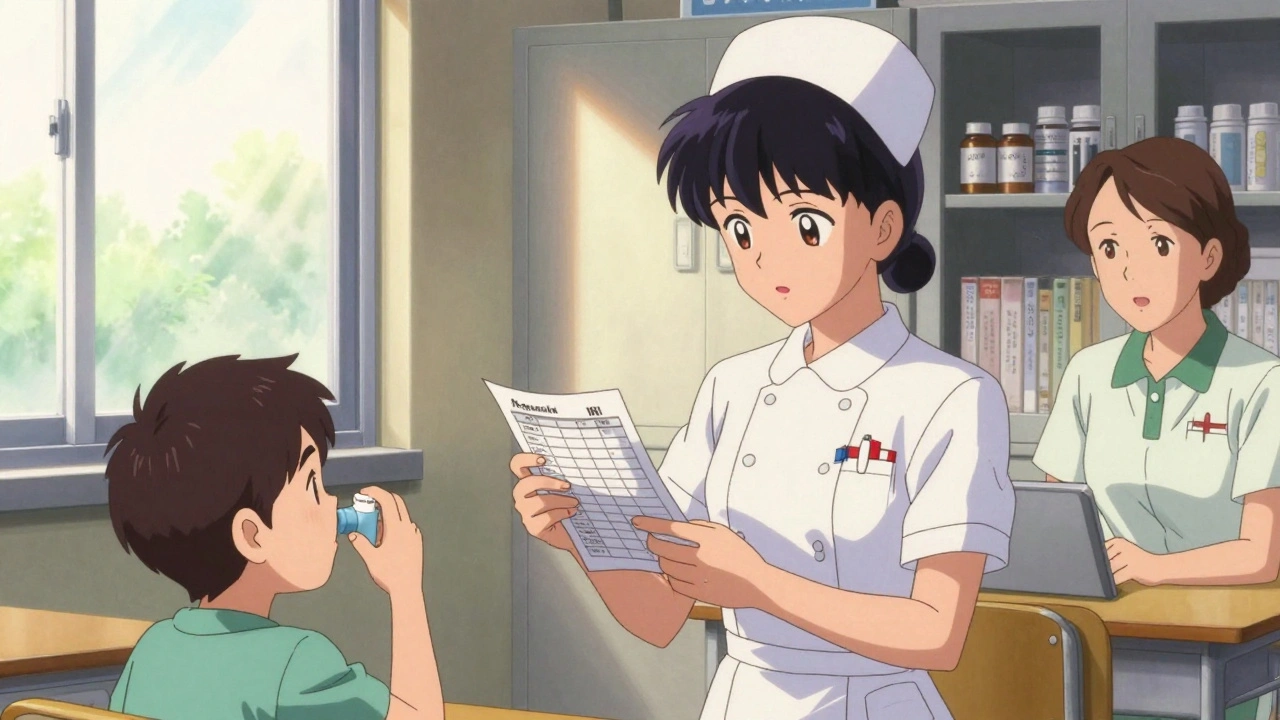
Every morning, hundreds of thousands of children across the U.S. take their asthma inhalers, insulin shots, or ADHD meds right in the middle of math class. It’s not magic. It’s not luck. It’s the quiet, careful work of school nurses and trained staff making sure those medications are given safely, on time, and correctly. But coordinating this isn’t just about handing out pills. It’s a complex system built on rules, training, documentation, and constant communication - and getting it wrong can put a child’s life at risk.
Why School Nurses Are the Linchpin
School nurses don’t just treat scraped knees. They’re the central hub for managing daily pediatric medications. A child with type 1 diabetes needs insulin at precise times. A kid with severe allergies might need an epinephrine shot within minutes of a reaction. These aren’t routine tasks - they’re medical interventions that require clinical judgment. That’s why the Five Rights of medication administration are non-negotiable: right student, right medication, right dose, right route, right time. Every single time.The National Association of School Nurses (NASN) made this official in their 2022 Clinical Practice Guideline. It’s the gold standard. And it’s backed by the American Academy of Pediatrics (AAP) as of June 2024. Schools that follow this model reduce medication errors by up to 37%. That’s not a small number. It’s life-saving.
But here’s the reality: only 1 in 3 school nurses have the recommended student-to-nurse ratio of 1:750. The national average is 1:1,102. In rural areas, it’s worse. So nurses can’t do it all alone. That’s where delegation comes in.
Delegation: When Nurses Train Others
Nurses can’t be in 20 classrooms at once. So they train other school staff - aides, teachers, even office workers - to give medications under their supervision. But this isn’t a quick handoff. It’s a formal process.Before anyone else touches a pill, the nurse must:
- Assess the student’s medical needs
- Evaluate the staff member’s competence
- Complete a written delegation agreement
- Provide training that lasts between 4 and 16 hours, depending on how complex the medication is
For example, giving a daily oral pill for ADHD might take 4 hours of training. But giving insulin via pump or managing a seizure medication with strict timing? That’s 16 hours - minimum. Virginia’s model, which requires the nurse to personally observe the first dose of any new medication, has been shown to cut adverse events by 22% compared to states without that rule.
And here’s the catch: 37 states allow unlicensed personnel to give meds, but rules vary wildly. Texas treats it like an administrative task - not a nursing function. That creates legal gray zones. A 2022 analysis found districts using this model had 14% higher liability risk. That’s not worth the risk.
Storage, Labels, and Paperwork: The Hidden Rules
You’d think giving a pill is simple. But the rules around storage and labeling are strict - and federal.Every medication must come in its original pharmacy container. No ziplock bags. No bulk bottles. No “I’ll just pour it into this cup.” Federal law (21 CFR § 1306.22) requires labels to include the child’s name, drug name, dose, instructions, and pharmacy info. If a school uses unlabeled meds, they’re breaking the law. And it’s happened. The Texas Department of State Health Services says this is non-negotiable.
Controlled substances - like Adderall or Ritalin - need extra security. They’re locked in double-locked cabinets. Two people must count them at the start and end of each day. That’s not bureaucracy. That’s to prevent theft or misuse.
And then there’s documentation. Every single dose must be recorded - immediately. Time, dose, student response, any side effects. Ninety-eight percent of districts use electronic systems now. But 42 states still allow paper logs. Paper means mistakes. Missed entries. Lost sheets. One nurse in Ohio lost a logbook during a fire. Two weeks of medication records gone. The child’s doctor had to re-prescribe everything.
Individualized Healthcare Plans (IHPs): The Blueprint
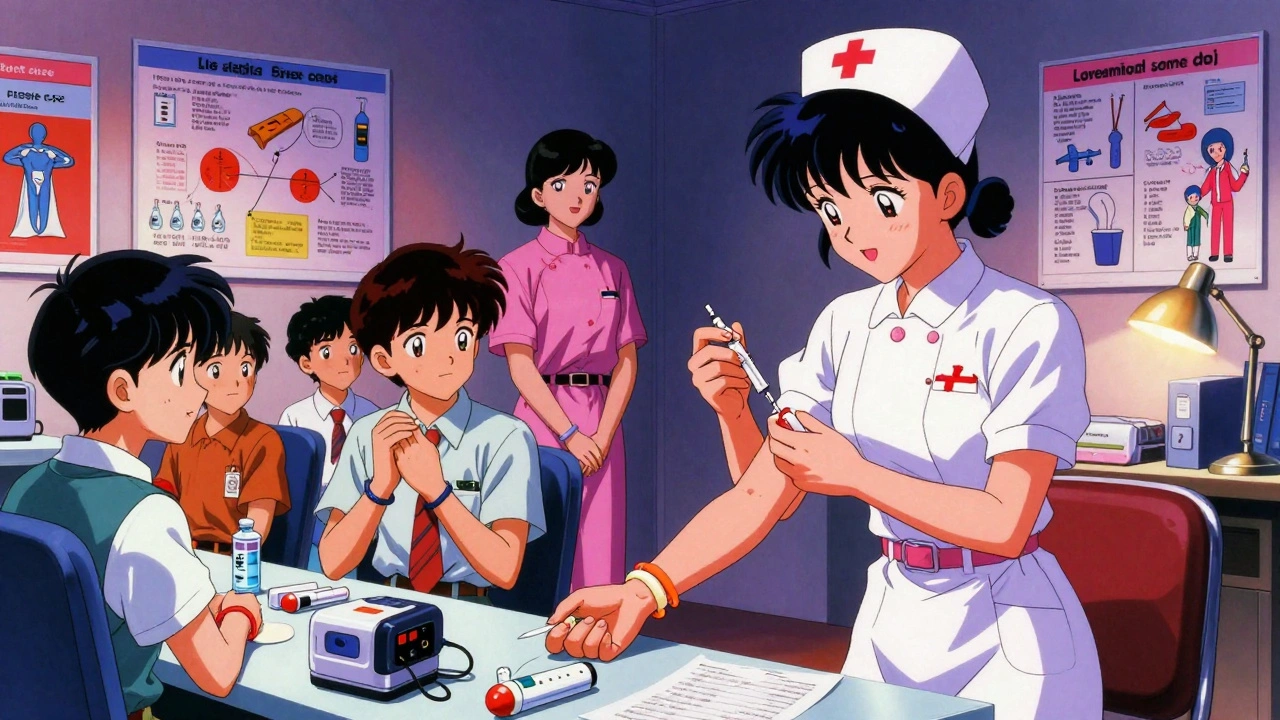
Not all kids are the same. A child with epilepsy needs a different plan than one with seasonal allergies. That’s where the Individualized Healthcare Plan (IHP) comes in. It’s not optional. If a child has a chronic condition covered under Section 504 or IDEA, the school must have an IHP.An IHP includes:
- Medication schedule
- Emergency procedures
- Who’s trained to give meds
- Communication plan with parents and doctors
- Special needs during field trips or sports
Creating one takes 2-4 hours per student. But districts that use IHPs see 28% better medication adherence than those that just rely on generic logs. That’s because the plan is tailored. It’s not a one-size-fits-all checklist. It’s a living document reviewed every semester.
Technology Is Changing the Game
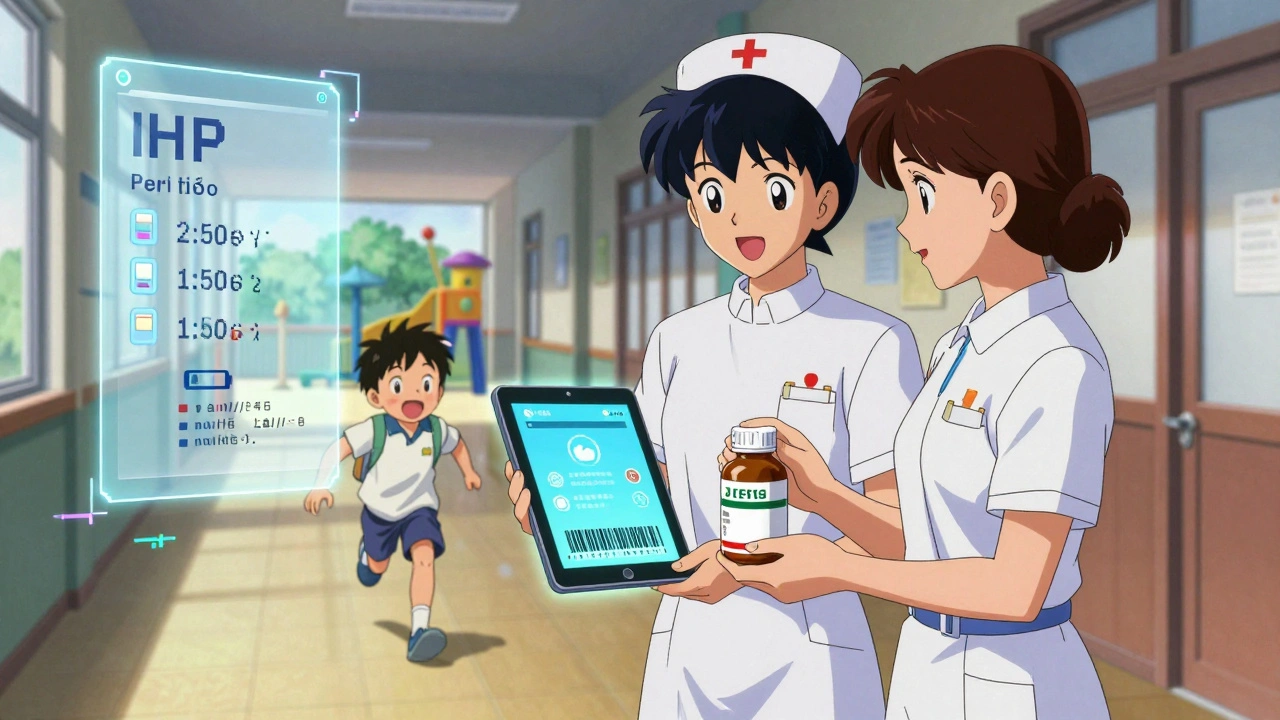
The best districts aren’t just keeping paper logs anymore. They’re using digital systems. Fairfax County Public Schools in Virginia switched to an electronic medication tracking system. Result? Documentation time dropped by 45%. Accuracy jumped 31%. Nurses got back hours each week.Now, 63% of districts are piloting smartphone-based verification apps. These apps scan the medication barcode, confirm the student’s ID, log the time, and even send alerts if a dose is missed. Some even connect to parents’ phones - so they know the med was given at school.
But tech isn’t a fix-all. It still needs human oversight. A nurse must verify the system’s data. A parent must still provide the original labeled bottle. And if the Wi-Fi goes down? You need a backup plan - usually paper.
What Goes Wrong - And How to Fix It
The biggest problems? Time, training, and inconsistent rules.Seventy-six percent of school nurses say they don’t have enough time to document properly. Rural nurses are hit hardest. Eighty-two percent report feeling overwhelmed. The solution? Standardized templates. NASN’s Implementation Toolkit includes pre-written policies, delegation forms, and training checklists. Districts that use them report 89% satisfaction.
Another issue: parents bringing meds in unlabeled containers. In 38% of districts, this happens regularly. The fix? Mandatory parent education sessions. Montgomery County, Maryland, started requiring parents to attend a 30-minute orientation before meds are accepted. Compliance jumped 52%.
And then there’s the emotional toll. Nurses fear making a mistake. That’s why the “Just Culture” framework matters. Instead of punishing errors, it asks: What went wrong in the system? A nurse in Texas shared on Reddit that her district’s non-punitive reporting system reduced staff anxiety by 70%. That’s huge. When people aren’t scared to report a near-miss, the whole system gets safer.
The Bottom Line: Safety Starts with Structure
Coordinating daily pediatric medications in schools isn’t about being busy. It’s about being smart. It’s about following the Five Rights every time. It’s about training the right people, storing meds the right way, documenting everything, and having a plan for every child.The data is clear: districts that follow the NASN guidelines have fewer errors, less liability, and happier staff. The cost? Around $187 per student per year. The benefit? A child gets their medicine on time, safely, and without fear.
It’s not perfect. Staffing is short. Rules vary by state. But the framework exists. The tools are available. And the children are counting on it.
Can a teacher give a child medication at school?
Yes - but only if a school nurse has formally delegated the task after assessing the child’s needs and the staff member’s training. Teachers can’t decide on their own. They must follow written protocols, use original labeled containers, and document every dose. In most states, this requires 4-16 hours of nurse-led training.
What if a parent brings medication in a ziplock bag?
The school cannot accept it. Federal law requires all medications to be in the original pharmacy-labeled container with the child’s name, drug, dose, and instructions. Schools that accept unlabeled meds risk violating drug regulations and opening themselves to legal liability. Parents must be educated - and in some districts, they must attend a training session before meds are accepted.
Do school nurses need to be present for every medication dose?
No - but they must supervise the process. Nurses assess which staff can give meds, train them, review documentation daily, and conduct spot checks. For high-risk medications like insulin or epinephrine, the nurse may need to administer the first dose personally. After that, trained staff can give it under the nurse’s oversight.
How often should medication logs be reviewed?
Daily. Every dose must be recorded immediately after administration. Nurses should review logs at the end of each day to catch errors or missing entries. Monthly error reviews with staff are required to improve the system - and to follow the “Just Culture” model that reduces fear and increases reporting.
What’s the difference between an IHP and a 504 Plan?
A 504 Plan is a legal document that ensures a child with a disability gets accommodations. An IHP is the medical plan that details exactly how medications are given, who gives them, and what to do in an emergency. Every child with a chronic condition needing daily meds should have both. The IHP supports the 504 Plan with clinical details.
Are epinephrine auto-injectors required in schools?
All 50 states allow schools to stock epinephrine, and 87% do. But only 24 states require it. The CDC recommends stock epinephrine be available for any student with a known allergy - or even unknown ones. Schools with stock epinephrine must have staff trained to use it and protocols to administer it within 5 minutes of symptom onset.
Can a school refuse to give a child their medication?
No - if the child has a documented medical need under Section 504 or IDEA, the school is legally required to provide it. Refusing could mean losing federal funding. But the school can require proper documentation: a doctor’s order, original labeled medication, and an IHP. If parents don’t provide these, the school can delay administration until they do.




13 Comments
Stephanie Fiero
Dec 5 2025So many schools are cutting nursing staff and expecting teachers to just wing it with meds. I’ve seen it firsthand-kids getting their ADHD pills at 10:45 because the teacher forgot to check the schedule. No one’s training them right, and the paperwork? Half the time it’s scribbled on napkins. We need funding, not just guidelines. This isn’t babysitting, it’s healthcare.
And don’t get me started on parents showing up with pills in ziplocks. You wouldn’t hand your dog a human pill in a sandwich bag, why is this acceptable for kids?
Laura Saye
Dec 6 2025The IHP framework is the only thing that truly bridges clinical necessity with educational accessibility. Without individualized planning, you’re reducing complex neurodevelopmental and physiological needs to a checkbox on a form. The real tragedy isn’t the staffing ratios-it’s that we treat medication administration as a logistical problem rather than a relational one.
Every dose is a moment of trust. When a child swallows their insulin because a trained aide remembers to check their glucose trend from yesterday, that’s not compliance-that’s care. And care requires presence, not just protocol.
Michael Dioso
Dec 7 2025Let me guess-the NASN guideline is the new bible now? You know what’s funny? The same people pushing this ‘gold standard’ are the ones who also want to ban crayons because they’re ‘unsafe.’
Training a teacher to give a pill is not rocket science. If you can’t trust a grown adult to follow a label, maybe they shouldn’t be around children at all. Stop over-medicalizing school. Kids used to take their meds in the nurse’s office without a 16-hour seminar and a signed waiver from the Vatican.
Kylee Gregory
Dec 9 2025I’ve worked in three different districts, and I can tell you-the ones with the best outcomes aren’t the ones with the most nurses. They’re the ones with the most trust.
When a teacher feels empowered, not policed, when a parent isn’t scared to call in because they forgot the bottle, when the nurse isn’t drowning in paperwork-then the system works. The Five Rights matter, sure. But the Five Trusts matter more: trust in training, trust in communication, trust in accountability, trust in humanity, trust in each other.
That’s what turns policy into practice.
Lucy Kavanagh
Dec 9 2025Oh wow, so now the government wants to control what meds kids get at school? First it’s masks, then it’s vaccines, now it’s who can give a pill? Who’s behind this? Big Pharma? The CDC? The UN? They’re slowly turning every school into a medical clinic with federal oversight. And you’re all just nodding along like good little drones.
My kid takes his Adderall at home. Why should a stranger in a school be touching his meds? This is slippery slope territory. Next they’ll be injecting insulin in gym class.
Krishan Patel
Dec 10 2025Let us be clear: the American public school system has become a bureaucratic graveyard of compliance over compassion. The NASN guidelines are not a solution-they are a symptom of a system that has outsourced parenting to institutions that are ill-equipped to handle it.
The real issue is not the 1:1,102 ratio-it’s the collapse of familial responsibility. Parents who cannot manage their child’s medication at home should not be allowed to send them to school. If you cannot be a parent, do not expect the state to be your surrogate.
And for heaven’s sake, stop using ‘Just Culture’ as a shield for incompetence. Accountability is not cruelty. It is civilization.
sean whitfield
Dec 11 2025Wow. So we need a PhD to give a child a pill now? Next they’ll make us pass a background check to hand out band-aids.
Meanwhile, the school has 20 kids in a class, no art program, and a counselor who hasn’t slept in 3 weeks. But hey, let’s spend $187 per kid on barcode scanners and double-locked cabinets. Priorities, people.
Also, ‘original pharmacy container’? That’s why we can’t have nice things. My kid’s inhaler came in a box with a QR code that links to a TikTok ad for oat milk. That’s the ‘label’ now.
Carole Nkosi
Dec 11 2025You think this is about kids? No. This is about liability. About insurance. About lawyers. The real goal isn’t safety-it’s protection from lawsuits. The Five Rights? That’s not medical ethics. That’s legal theater.
And don’t pretend the tech solutions are helping. Every digital log is another way to track, monitor, and control. We’re turning children into data points. The nurse isn’t caring for a child-she’s auditing a protocol.
Where’s the heart in this?
Stephanie Bodde
Dec 13 2025YES. YES. YES. 🙌
I’m a nurse in a rural district and I cry every time I have to choose between checking on a diabetic kid or filling out the 17 forms for the next kid’s asthma med. We need help. We need more staff. We need parents to stop bringing meds in plastic bags. We need training. We need support. And we need people to stop acting like this is easy.
You want to help? Advocate for funding. Volunteer to be trained. Don’t just complain on Reddit.
Thank you for writing this. I needed to read it today. 💙
Philip Kristy Wijaya
Dec 13 2025Let me be perfectly blunt-the entire structure described here is a monument to institutional cowardice
Why train teachers at all Why not just have every child go to a clinic after school Why not have parents administer meds before and after the school day Why outsource responsibility to underpaid staff who are not licensed Why not acknowledge that the modern school is not a medical facility
This isn’t innovation This is surrender dressed in clipboards and barcodes
The system is broken because we refuse to ask the fundamental question: why are children taking powerful psychotropic and life-sustaining drugs during math class in the first place
Fix the root cause not the paperwork
luke newton
Dec 15 2025My kid has ADHD. He’s on Ritalin. I don’t care how many forms you fill out or how many cabinets you lock. If the school doesn’t give him his meds on time, he’s going to meltdown in the hallway and get suspended for ‘disruptive behavior.’
And then they wonder why kids hate school.
You think this is about rules? It’s about dignity. If you can’t give a kid his medicine because you’re too scared to delegate, then you’re not protecting him-you’re punishing him.
And if you think a ziplock bag is the real problem, you’re missing the point. The real problem is that we treat children like legal liabilities, not human beings.
Ali Bradshaw
Dec 16 2025My sister’s a school nurse in Scotland. They do it differently here. Nurses aren’t expected to do it all. Teachers get basic training. Parents are involved from day one. No double-locked cabinets for asthma inhalers-just a locked drawer. No barcode scanners. Just trust, training, and a shared commitment.
They have fewer errors. Lower stress. And the kids? They’re just kids. Not patients on a spreadsheet.
Maybe we don’t need more rules. Maybe we need to remember that people are better than systems.
Chris Brown
Dec 17 2025It is both morally and legally indefensible to permit unlicensed personnel to administer life-sustaining pharmaceuticals under any circumstance. The practice of delegation, as currently implemented across thirty-seven states, constitutes a gross dereliction of professional responsibility and an affront to the sanctity of clinical licensure. The American Academy of Pediatrics, while well-intentioned, has compromised its ethical mandate by tacitly endorsing this erosion of standards. There is no such thing as ‘adequate’ training when the stakes involve pediatric neurology or endocrinology. The only acceptable model is one in which a registered nurse, holding current certification and possessing direct clinical authority, administers every single dose-period. No exceptions. No compromises. No convenience. The child’s life is not a logistical problem to be optimized-it is a sacred trust. Any deviation from this principle is not innovation-it is negligence dressed in bureaucratic jargon.