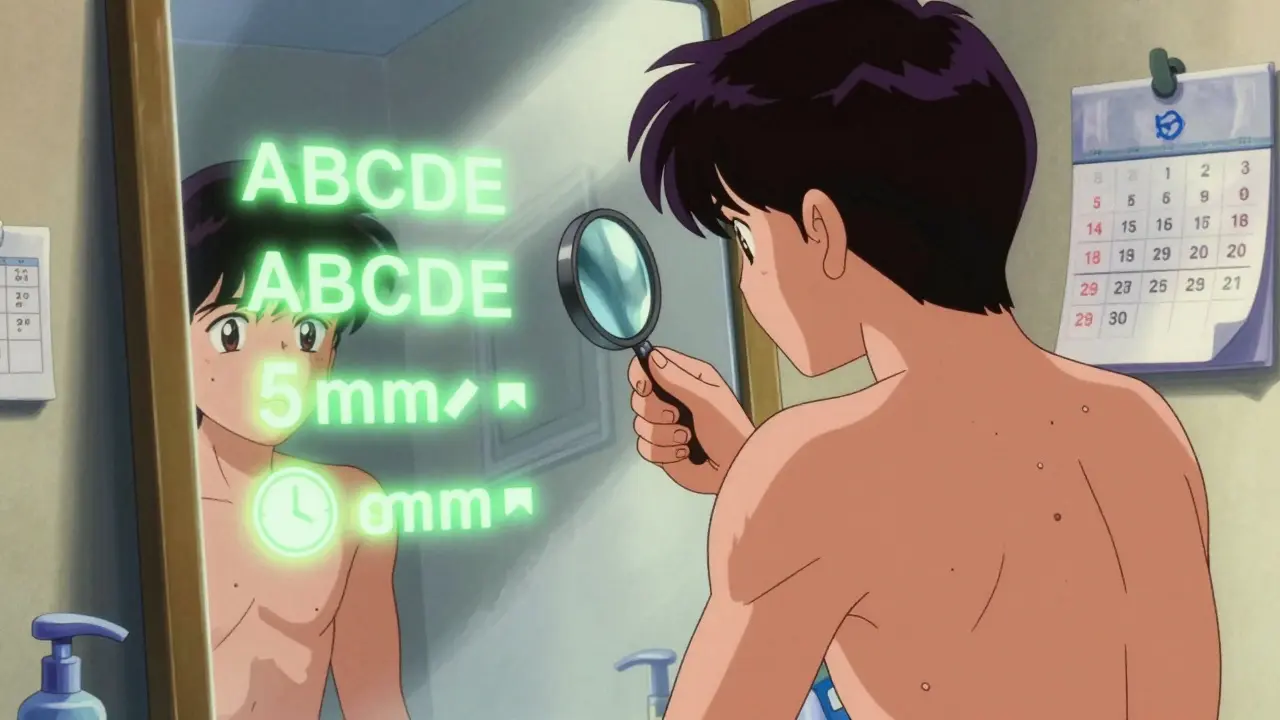
Most people have moles. Some are harmless. Others? They’re not. The difference can mean the difference between catching melanoma early - when it’s nearly 100% curable - and waiting too long, when survival rates drop sharply. You don’t need to be a doctor to spot warning signs. The ABCDE rule is the simplest, most widely used tool for this. But here’s the truth: it’s not perfect. And relying on it alone might let a dangerous mole slip through.
What the ABCDE Rule Actually Means
The ABCDE rule breaks down melanoma warning signs into five easy-to-remember traits. It was developed in the 1980s by dermatologists like Dr. Darrell Rigel to help both doctors and regular people recognize trouble. Today, it’s printed on posters in clinics, taught in schools, and used in apps. But what do the letters really mean?
- A for Asymmetry: One half of the mole doesn’t match the other. If you drew a line through the middle, the two sides wouldn’t look the same.
- B for Border irregularity: The edge is uneven, ragged, blurred, or not smooth like a pencil line. Melanomas often have jagged borders.
- C for Color variation: A mole with multiple shades - black, brown, tan, red, white, or blue - is a red flag. Normal moles are usually one consistent color.
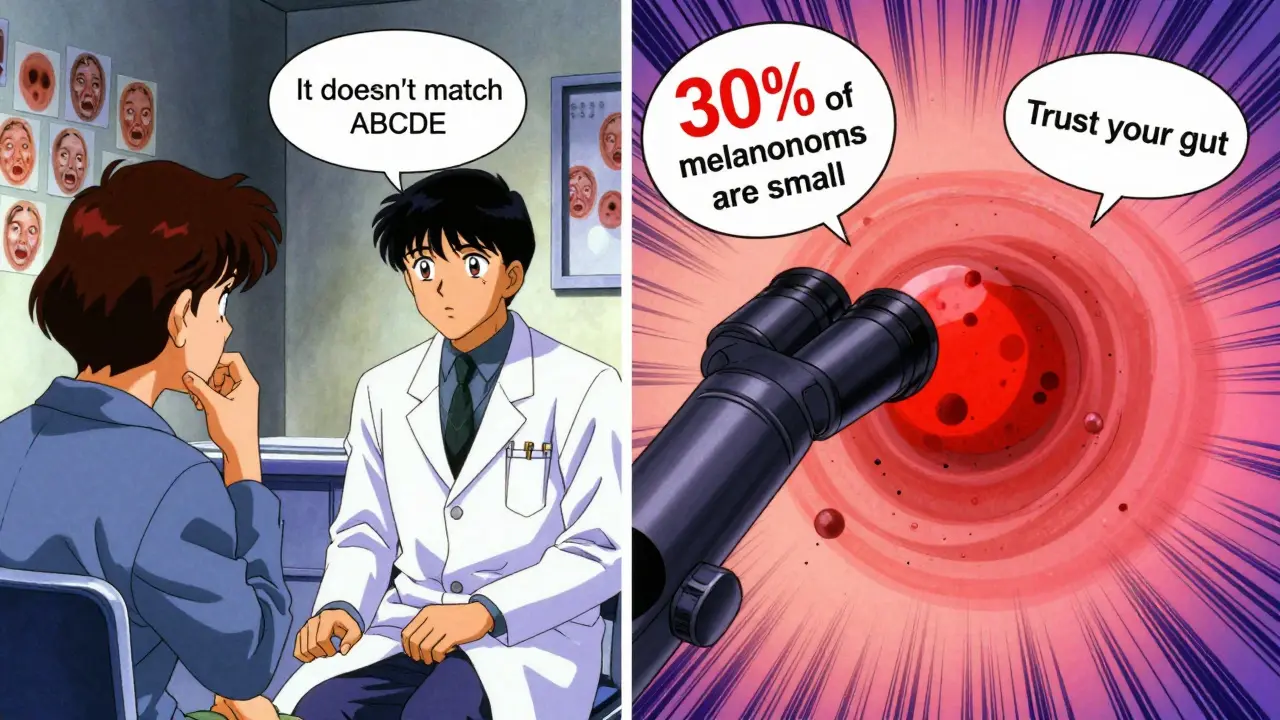
- D for Diameter: Traditionally, this meant larger than 6 millimeters - about the size of a pencil eraser. But newer guidelines from Phoenix Surgical Dermatology Group and others now say 5 millimeters is the real cutoff. And here’s the twist: 30% of melanomas are found when they’re smaller than this. Some experts now interpret "D" as "Dark" - if a mole is darker than your other moles, it’s worth checking.
- E for Evolving: This is the most important sign. Any change in size, shape, color, or texture over weeks or months matters. New itching, bleeding, or crusting? That’s a major signal.
Some organizations have added "F" for "Funny looking" and "G" for "Growing rapidly," but the core five still hold the most weight. The Skin Cancer Foundation says evolving is the single most sensitive feature - present in 60-70% of melanomas.
Why the ABCDE Rule Misses Melanomas
Here’s the uncomfortable truth: not all melanomas look like the textbook examples. A 2022 study in PubMed looked at 144 melanoma cases and found that 36% were in situ - the earliest, most treatable stage. But here’s the kicker: only 32.7% of those early melanomas showed the "E" sign (evolving). That’s far lower than the 50% seen in invasive cases.
Some melanomas are perfectly symmetrical. Others are uniform in color. Some are tiny - under 3mm. I’ve seen patients come in with a mole that looked like every other mole on their body. No asymmetry. No color change. No border issues. But it was stage IIB melanoma. One patient told me: "It didn’t meet any ABCDE criteria. I thought I was fine. I waited six months before going in."
Dr. Allan Halpern from Memorial Sloan Kettering puts it bluntly: "Not all melanomas fit the ABCDE rule." He’s right. About 20-30% of melanomas lack classic features. That’s why dermatologists don’t rely on ABCDE alone.
The Ugly Duckling Sign: What the Rule Doesn’t Tell You
There’s another, simpler rule that works better for some people: the "ugly duckling" sign. It means: "Which mole looks different from all the others?"
You don’t need to know what asymmetry or border irregularity means. You just need to look at your skin and ask: "Does anything stand out?" A 2019 study in the British Journal of Dermatology found this method caught 73% of melanomas that the ABCDE rule missed.
Imagine you have 15 moles. Fourteen are small, brown, round, and unchanged. One is darker, slightly raised, and has a blurry edge. Even if it’s only 4mm and symmetrical - that’s your ugly duckling. That’s the one to get checked.
Many patients don’t know their own skin well enough to spot this. That’s why dermatologists recommend monthly self-checks. Use a mirror. Take photos. Compare. The American Academy of Dermatology’s body mole map tool has been downloaded over 1.2 million times in the last year. People who use it are more likely to catch changes early.
When Does a Mole Need a Biopsy?
Not every odd-looking mole needs surgery. But when should you say yes?
Dermatologists use three main triggers:
- Three or more ABCDE signs - this gives you about 85% sensitivity. But if you only have one or two, don’t assume you’re safe.
- Documented change over 3-6 months - even if it looks "normal," if it grew, darkened, or started itching, that’s a strong reason to biopsy. Sensitivity jumps to 92% here.
- The ugly duckling sign - if one mole looks completely different from the rest, biopsy it. Sensitivity: 73%.
Many patients don’t have photos of their moles from months ago. The Skin Cancer Foundation says only 19% do. That makes it hard to prove "evolving." If you’re worried, take a clear, well-lit photo today. Compare it in six months.
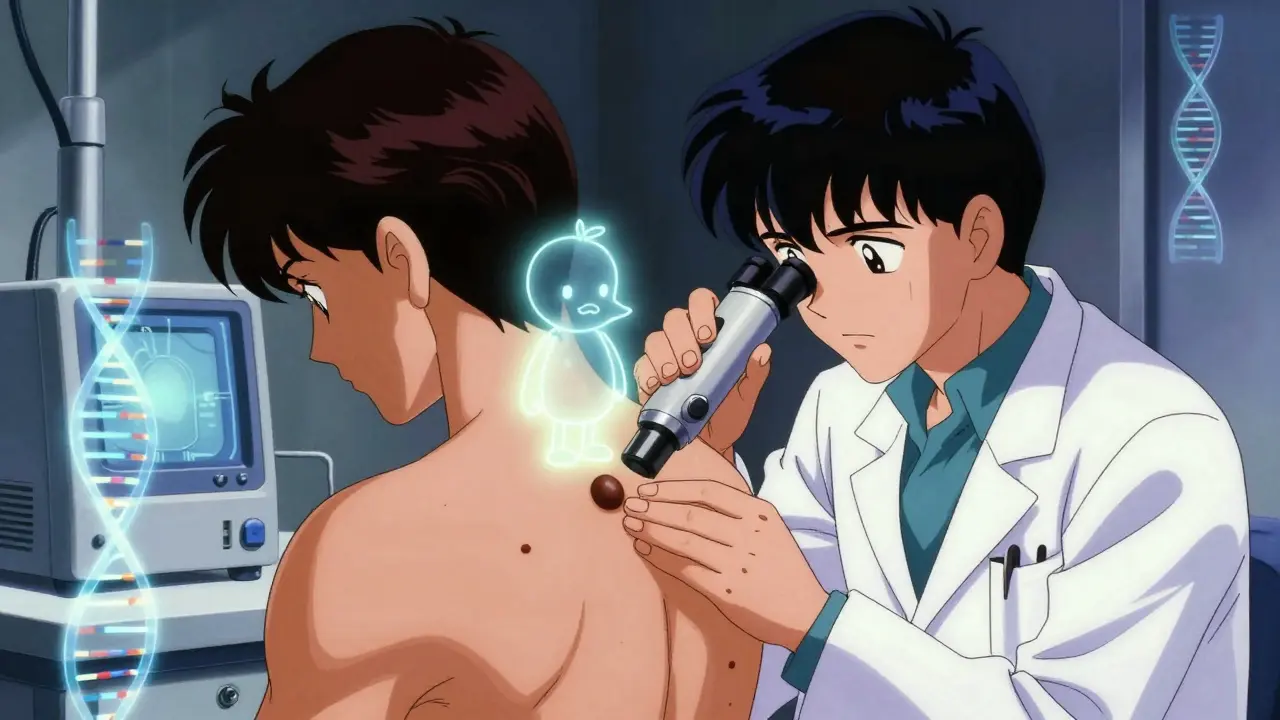
Dermatologists also use dermoscopy - a handheld magnifier with polarized light. It’s available in 85% of U.S. dermatology practices. Studies show it raises diagnostic accuracy from 75% to 92%. But it’s not something you can do at home.
The Hidden Cost of False Alarms
Using ABCDE increases awareness - but it also leads to a lot of unnecessary biopsies. A 2022 study in JAMA Internal Medicine found that for every melanoma detected using ABCDE, 4.7 benign moles are removed. That’s expensive. The U.S. healthcare system spends $417 million a year on these false positives.
And it’s not just money. It’s anxiety. A 2022 survey by the American Academy of Dermatology found 42% of patients delayed seeing a doctor because their mole "didn’t meet enough ABCDE criteria." The average delay? Over seven months.
Some dermatologists now use AI tools. The FDA approved SkinVision in March 2022 - an app that analyzes moles using ABCDE plus extra algorithms. In trials, it caught 95% of melanomas. It’s not perfect, but it’s a helpful second opinion. As of late 2023, 43% of U.S. dermatology practices use AI-assisted tools like this.
What to Do If You’re Worried
Don’t wait for a perfect match to the ABCDE rule. If a mole:
- Changes - even slightly - over weeks or months
- Looks different from your other moles
- Starts itching, bleeding, or crusting
- Is darker than your other moles, even if small
- Is on a part of your body that gets sun exposure (back, legs, face)
…get it checked. You don’t need to be an expert. You just need to be curious.
Annual skin checks with a dermatologist are recommended for people with a history of sunburns, family history of melanoma, or more than 50 moles. But you don’t need to wait for your yearly visit. If something feels off, go now.
The Future of Melanoma Detection
The ABCDE rule isn’t going away. But it’s no longer the whole story. The International Dermoscopy Society launched "ABCDE 2.0" in January 2023 - a version that blends the old rule with AI, dermoscopy, and molecular testing.
One new tool, DecisionDx-Melanoma, is a gene test that analyzes a mole’s DNA. It’s used in 68% of academic dermatology centers. It can tell if a mole is likely to spread - even if it looks benign. This helps avoid unnecessary surgeries.
Dr. Lynn Schuchter from the University of Pennsylvania says: "By 2027, ABCDE will be the starting point for a multi-modal assessment - not the endpoint." That means: check the ABCDE signs. Then use photos, dermoscopy, or AI. Then decide.
For now, the best thing you can do is know your skin. Check it monthly. Take photos. Notice changes. And if something feels wrong - even if it doesn’t fit the ABCDE rule - get it looked at. Early detection saves lives. And sometimes, it’s not about the rules. It’s about trusting your gut.
Can a mole be melanoma even if it’s small?
Yes. While melanomas are often larger than 6mm, 30% are found when smaller than 5mm. Size alone isn’t a reliable indicator. A mole that’s changing, dark, or different from others - even if tiny - should be evaluated.
Do I need to check my moles every month?
Yes, especially if you have many moles, a history of sunburns, or a family history of melanoma. Monthly self-checks help you notice changes early. Use a mirror and take photos to compare over time. The American Academy of Dermatology offers a free body mole map to help with this.
Is the ABCDE rule enough to diagnose melanoma?
No. The ABCDE rule is a screening tool, not a diagnostic one. Many melanomas don’t fit the pattern. Dermatologists use dermoscopy, patient history, and sometimes biopsy to confirm. Relying only on ABCDE can miss early melanomas, especially in situ ones.
What if my mole doesn’t have any ABCDE signs?
That doesn’t mean it’s safe. About 20-30% of melanomas lack classic ABCDE features. If a mole looks different from your others (the "ugly duckling" sign), is growing, or has new symptoms like itching or bleeding, get it checked - regardless of ABCDE.
How accurate is dermoscopy compared to visual inspection?
Dermoscopy increases diagnostic accuracy from 75% to 92%. It allows dermatologists to see structures beneath the skin’s surface that aren’t visible to the naked eye. It’s standard in most dermatology practices but not available for home use.


8 Comments
Melissa Starks
Mar 19 2026Look, I get that ABCDE is a tool, but honestly? It’s like using a ruler to measure a cloud. I’ve got 27 moles, and half of them look like they’re trying to escape my skin. One’s been growing since college-tiny, dark, no asymmetry, no border weirdness-but it just feels "off." I took a photo last June. This June? It’s bigger. And no, I didn’t wait for it to tick all five boxes. I went in. Biopsy came back: early melanoma. The doctor said if I’d waited for "E" to hit, I’d have been in stage II. So yeah, the rule’s a start. But your gut? That’s the real diagnostician.
Also, stop telling people to "just check monthly." Most of us have jobs, kids, and zero time. I use a dumb app that reminds me every 30 days. Took 30 seconds to snap a pic. That’s all it takes. No need to turn it into a full-body ritual. Just be consistent. And if something looks like it’s auditioning for a horror movie? Get it checked. Period.
Alexander Pitt
Mar 19 2026The ABCDE rule is a screening heuristic, not a diagnostic criterion. It was never intended to replace clinical judgment or dermoscopy. The sensitivity figures cited in the article are accurate: 60-70% for evolving lesions, but only 40-50% for early in situ melanomas. The real issue is overreliance. Dermatologists use pattern recognition-global asymmetry, blue-white structures, regression features-not just ABCDE. The ugly duckling sign is clinically superior for population screening because it leverages innate visual pattern discrimination. Studies show it reduces false negatives by 22% compared to ABCDE alone. AI tools like SkinVision add value, but they’re still probabilistic. The gold standard remains histopathology. Always.
Also, 4.7 benign biopsies per melanoma? That’s acceptable in oncology. We biopsy a lot of benign lesions to catch one cancer. It’s called risk mitigation. The cost is not a failure-it’s the price of early detection.
Emily Hager
Mar 21 2026While I appreciate the thoroughness of this exposition, I must take issue with the casual dismissal of the ABCDE rule’s foundational utility. The very premise that one should abandon systematic evaluation in favor of subjective intuition is, frankly, antithetical to evidence-based medicine. The "ugly duckling" sign, while intuitively appealing, lacks standardized operational criteria and is subject to interobserver variability. Moreover, the reliance on photographic comparison introduces significant confounding variables: lighting, angle, resolution, and skin tone rendering. Without calibrated imaging protocols, such methods are statistically unreliable. Furthermore, the notion that patients should "trust their gut" when confronted with dermatological ambiguity is not only scientifically indefensible-it is dangerously paternalistic. The medical community must not abdicate its responsibility to educate patients in structured, reproducible frameworks. To do so is to invite diagnostic chaos.
Suchi G.
Mar 22 2026I'm from India, and I've been watching my moles since I was 16. We don't have dermatologists on every corner here. My mom had melanoma. She waited because she thought "it didn't look bad." She died at 52. I check my skin every Sunday. I don't care about ABCDE. I care about which mole looks like it's trying to bite me. One mole on my shoulder? It's always been there. But last year, it got a little bumpy. Not big. Not dark. Just... different. I went to a private clinic. They did dermoscopy. Said "probably benign" but still took a sample. Turned out to be stage 0. No surgery. Just a tiny excision. If I'd waited for "E" or "D"? I wouldn't be here typing this. So yeah, the rule is fine for textbooks. But real life? It's about noticing what doesn't belong. Even if it's just a speck. Especially if it's just a speck.
Also, take photos. Use your phone. Don't wait for an app. Just snap. Compare. Your eyes are better than any algorithm if you're paying attention.
Lauren Volpi
Mar 23 2026Okay but like, who even made this ABCDE thing? Some 1980s dermatologist with a PowerPoint? And now we’re all supposed to memorize it like it’s the Ten Commandments? Meanwhile, the real danger is that the system is rigged. Biopsies cost $1,200. Insurance won’t cover them unless you have "three ABCDE signs." So people wait. They get scared. They Google. Then they panic. And then? The AI app tells them it’s fine. Meanwhile, the dermatologist’s office is just another profit center. They want you to come in, get scanned, get billed. The whole thing is a money grab wrapped in medical jargon. I’ve got a mole that’s blacker than my coffee. It’s 2mm. Symmetrical. No border. But I’m not touching it. Why? Because I don’t trust any of this. The truth? Nobody knows what’s going on. And they’re selling you peace of mind for $89 a pop.
Robin Hall
Mar 24 2026Let me ask you this: if the ABCDE rule is so fallible, why hasn’t it been replaced? Why is it still the gold standard in every medical textbook, every public health campaign, every dermatology residency curriculum? Because it’s not about accuracy-it’s about control. The pharmaceutical-industrial complex has invested billions in the narrative that melanoma is preventable through vigilance. But what if the real problem isn’t moles? What if it’s glyphosate? What if it’s the 37 chemicals in your sunscreen? What if the FDA’s approval of SkinVision was a distraction tactic to shift focus away from systemic toxicity? The 92% accuracy of dermoscopy? That’s a number cooked in a lab with filtered light and idealized skin tones. Real people live in the sun. Real people have eczema. Real people don’t have $300 to spend on a dermatologist visit. And yet, here we are-obsessed with moles while ignoring the real carcinogens in our air, our water, our food. The ABCDE rule is a smokescreen. A distraction. A way to make you feel like you’re in control… while the real threat grows silently.
Jeremy Van Veelen
Mar 25 2026How profoundly tragic that we’ve reduced the existential dread of cancer to a five-letter mnemonic. The ABCDE rule is not merely inadequate-it is a cultural artifact of a society that confuses simplicity with wisdom. To believe that melanoma, a disease of genetic mutation, cellular dysregulation, and environmental carcinogenesis, can be apprehended through a checklist designed for laypeople in the pre-digital era is to misunderstand the very nature of biology. The ugly duckling sign? A poetic metaphor, yes-but one that lacks the rigor of a true diagnostic paradigm. We are not cavemen staring at the sky, trying to divine meaning from shapes in clouds. We are the inheritors of genomics, of AI-assisted histopathology, of molecular profiling. And yet, here we are, clinging to a 1980s heuristic like a security blanket. The future is not in your phone camera. It is in the sequencing of BRAF, NRAS, and TERT promoter mutations. It is in the epigenetic signatures of melanocytes under ultraviolet duress. To speak of moles as if they are mere aesthetic anomalies is to speak in tongues. We have the tools to transcend the ABCDE rule. Why are we still using it?
Melissa Stansbury
Mar 27 2026I just got my biopsy results back. Benign. But I still cried. Not because I was scared-I was-but because I realized I didn’t even know what my own skin looked like. I’ve had moles since I was a kid. Never checked. Never photographed. Never compared. I thought I was fine. I thought I was safe. I didn’t even know the "ugly duckling" was a thing until I read this. I’m going to start taking monthly photos. I’m going to learn what normal looks like on me. Not because I’m scared of cancer. But because I owe it to myself to pay attention.