
Digoxin-Amiodarone Dose Adjuster
Calculate Your Safe Digoxin Dose
When starting amiodarone, digoxin must be reduced by 50% to prevent life-threatening toxicity. This tool helps calculate the correct dose adjustment.
Recommended dose: 50% reduction
Based on guidelines from the European Heart Rhythm Association and American Society of Health-System Pharmacists
Critical Safety Note
Amiodarone increases digoxin levels by 100% or more. Even with dose adjustment, you must monitor blood levels:
- Check digoxin levels before starting amiodarone
- Check levels again at 72 hours after starting amiodarone
- Check again at 7-14 days for full effect
Why This Drug Pair Can Be Deadly
Imagine taking two heart medications that are meant to save your life-only to find out they’re working together to push your body over the edge. That’s exactly what happens when digoxin and amiodarone are used together. Both drugs are powerful, both are used for heart rhythm problems, and both have a razor-thin line between helping and harming. Digoxin’s safe range? Just 0.5 to 0.9 nanograms per milliliter in the blood. Go a little above that, and you risk nausea, blurry vision, dangerous heart rhythms, or even death. Amiodarone doesn’t just add to the problem-it multiplies it.
This isn’t a rare mistake. In U.S. hospitals, nearly 1 in 3 patients on digoxin who start amiodarone keep their full digoxin dose-despite decades of warnings. A 2022 study across 15 major hospitals found that only 44% of patients had their digoxin dose lowered when amiodarone was added. In community clinics, the number dropped to just over 30%. The result? Preventable ICU admissions, kidney failure, and deaths that could have been avoided with a simple dose change.
How the Interaction Works
Amiodarone doesn’t just sit next to digoxin-it actively changes how your body handles it. The main culprit? A protein called P-glycoprotein. This protein normally acts like a pump, pushing digoxin out of your cells and helping your body get rid of it. Amiodarone shuts down that pump. Without it, digoxin builds up in your blood. Studies show this alone can raise digoxin levels by 100% or more.
But that’s not all. Amiodarone also slows down how fast your liver and kidneys clear digoxin. In one landmark study from 1984, patients on digoxin saw their digoxin clearance drop by nearly 30% after starting amiodarone. Their half-life-the time it takes for half the drug to leave the body-jumped from about two days to nearly three. That means digoxin doesn’t just stick around longer; it keeps piling up day after day.
And here’s the kicker: amiodarone sticks around even longer. With a half-life of up to 100 days, it doesn’t just affect digoxin while you’re taking it-it keeps affecting it for months after you stop. Even if you’ve been off amiodarone for six weeks, your digoxin levels can still be dangerously high.
What Happens When Toxicity Strikes
Early signs of digoxin toxicity are easy to miss. You might feel nauseous. Your vision might get blurry-yellow or green halos around lights are a classic red flag. You could feel dizzy, weak, or notice your heart skipping beats. But in older adults, especially those with kidney problems, symptoms often show up as sudden bradycardia-a dangerously slow heart rate-or high potassium levels that can trigger cardiac arrest.
A 2023 case report from Massachusetts General Hospital described a 72-year-old woman who developed a potassium level of 6.8 mEq/L (normal is 3.5-5.0) after starting amiodarone without adjusting her digoxin. She went into cardiac arrest. She spent four days in the ICU. She survived-but only because her team caught it in time.
And it’s not just about immediate danger. A 2023 analysis of the original DIG trial found that patients on both drugs had a 38% higher risk of dying within a year compared to those on digoxin alone. Another 2024 study linked the combo to more than double the risk of stroke, likely because high digoxin levels make blood more prone to clotting.
The Rule That Saves Lives
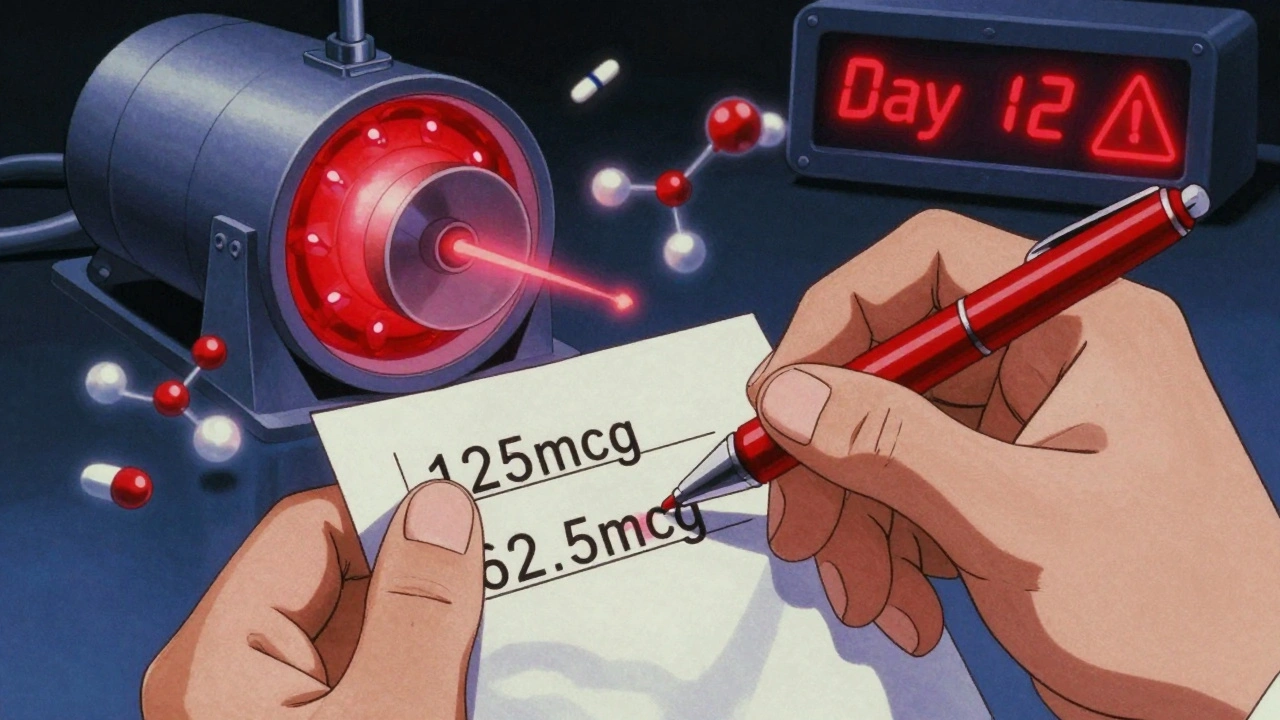
There’s one clear, proven way to prevent this: reduce the digoxin dose by 50% when you start amiodarone. That’s not a suggestion-it’s a standard backed by the European Heart Rhythm Association, the American Society of Health-System Pharmacists, and every major cardiology group since the 1980s.
And it’s not just about guessing. Guidelines say to check digoxin levels before starting amiodarone, then again at 72 hours after starting it. If the patient has kidney problems (creatinine clearance under 50 mL/min), cut the dose even further-to one-third of the original. Some hospitals, like UCSF, check levels again at 7 days and 14 days because the full effect can take up to two weeks to show.
One success story comes from the University of Michigan. Before they implemented a strict protocol-50% digoxin reduction, mandatory level checks within 72 hours-they saw digoxin toxicity in 12.3% of patients on both drugs. After? It dropped to 2.1%. That’s an 83% reduction in life-threatening events.
Why Doctors Still Miss It
You’d think this would be common knowledge by now. But here’s the reality: many doctors still don’t do it. Why?
- Amiodarone is used for emergencies. When a patient goes into atrial fibrillation and won’t respond to other drugs, amiodarone is given fast. Digoxin gets forgotten in the rush.
- It’s not in the EHR alert system. Many hospitals still don’t have smart alerts that pop up when both drugs are prescribed together. The Veterans Health Administration fixed this in 2021-when they added an alert, toxicity dropped by 41%.
- Patients look stable. Digoxin toxicity doesn’t always show up right away. A patient might be fine on day 3, so the doctor assumes everything’s okay. But the peak effect hits at day 10-14.
- Old habits die hard. Some clinicians still think, “I’ve given this combo for years and no one died.” But that’s survivorship bias. The ones who didn’t survive? They’re not in your clinic anymore.
One cardiologist on Reddit, verified and practicing in a major hospital, said: “I’ve seen three cases of digoxin toxicity from this combo in the past year alone-every single one in patients over 75 with kidney disease.”

What to Do If You’re on Both Drugs
If you’re taking digoxin and your doctor wants to add amiodarone, ask these questions:
- “Will you be reducing my digoxin dose?”
- “When will you check my digoxin blood level after starting amiodarone?”
- “What are the signs I should watch for-like nausea, vision changes, or a slow pulse?”
- “Should I get my kidney function checked before and after?”
Don’t assume your doctor knows. Bring a printed copy of the 50% dose reduction rule. Many pharmacists now carry these guidelines on their phones and can intervene if a prescription isn’t adjusted.
The Bigger Picture: Is Digoxin Still Worth It?
With all these risks, why do we still use digoxin at all? Because for some patients-especially those with heart failure and atrial fibrillation who can’t tolerate beta-blockers or calcium channel blockers-it’s still the best option. But it’s no longer a first-line drug for rhythm control.
The 2024 European Society of Cardiology guidelines now recommend beta-blockers or diltiazem as the first choice for rate control in atrial fibrillation-even if amiodarone is needed later. That’s a big shift. Since 2010, digoxin use in AF patients has dropped by 32% in the U.S. as doctors move toward safer alternatives.
Still, if you need digoxin and amiodarone together, don’t panic. Just make sure your team knows the rules. The interaction is dangerous-but it’s also completely preventable.
What’s Coming Next
Research is still evolving. The DIG-AMIO trial (NCT05217891), currently underway, is comparing whether a 50% or 33% digoxin dose reduction is safer when starting amiodarone. Results are expected in late 2025. Meanwhile, new drugs like dronedarone (a cousin of amiodarone) are showing similar risks, reinforcing that this isn’t just about one drug-it’s about a class of compounds that interfere with digoxin clearance.
For now, the message is simple: if you’re starting amiodarone, digoxin must be cut in half. No exceptions. No delays. No assumptions.



14 Comments
Evelyn Pastrana
Dec 9 2025So let me get this straight-we’re still using a drug that’s basically a poison unless you’re holding a measuring spoon? And we wonder why people die in hospitals. 🙄
Also, why is this not a mandatory pop-up in every EHR? I swear, if I had a dollar for every time a doctor missed this, I’d have bought a private island by now.
Arun Kumar Raut
Dec 11 2025This is so important. In India, many elders take digoxin for heart rhythm and then get amiodarone without anyone checking levels. Family members don’t even know to ask. We need more awareness, not just in hospitals but in villages too. A simple poster in the pharmacy could save lives.
Carina M
Dec 11 2025It is truly lamentable that such a well-documented, evidence-based interaction continues to be neglected with such alarming regularity. One might reasonably infer that the medical community’s adherence to clinical guidelines is not merely suboptimal-it is, in many cases, criminally negligent. The fact that this persists into the 2020s speaks volumes about systemic failures in continuing medical education and institutional accountability.
Ajit Kumar Singh
Dec 13 2025Ive seen this kill people in the ER and no one does anything until its too late why do we even have alerts if theyre just for show why do we even have guidelines if no one reads them i mean come on
Maria Elisha
Dec 15 2025Ugh I just read this and now I have to go ask my cardiologist if he’s actually read this post. I’m too lazy to print it out though. Someone do it for me.
Angela R. Cartes
Dec 16 2025I mean… I get it 😔 but also… why are we still using digoxin at all? Like, it’s 2025. Can’t we just… evolve? 🤷♀️❤️🩹
Andrea Beilstein
Dec 16 2025The real tragedy isn't the drug interaction it's that we treat medicine like a checklist instead of a conversation between a body and its caretakers
When did we stop listening to the patient and start listening to the algorithm
om guru
Dec 16 2025The clinical guidelines are clear and universally accepted. Any deviation from the 50% digoxin dose reduction protocol constitutes a breach of standard of care. Institutions must implement mandatory electronic alerts and pharmacist-led reconciliation protocols. Patient safety is non-negotiable.
Asset Finance Komrade
Dec 17 2025Perhaps the real issue isn't the drugs-but our obsession with control. We force pills into bodies like they're puzzle pieces, ignoring the fact that human physiology resists rigid categorization. Maybe we need less protocol and more humility.
Jennifer Blandford
Dec 17 2025I had my grandma on both of these meds and she almost didn’t make it. I printed out this whole article and handed it to her cardiologist. He actually read it. He apologized. She’s fine now. But why did it take me, a non-medical person, to save her life? 😭
Raja Herbal
Dec 18 2025Ah yes, the classic ‘I’ve been doing this for 20 years and no one died’ excuse. Meanwhile, the dead don’t show up for their follow-ups. 😏
Rich Paul
Dec 19 2025bro digoxin is like the t-rex of cardiac meds like yeah it used to rule but now we got better shit
amiodarone is basically a chemical gremlin that just sits in your liver and waits to ruin your day like 6 months later
Delaine Kiara
Dec 21 2025I just saw a TikTok about this and now I’m crying. I’m not even on these meds but I feel like I’ve been through a trauma. Someone needs to make a Netflix docuseries called ‘The Digoxin Murders’ with dramatic reenactments and slow zooms on EKGs.
Gilbert Lacasandile
Dec 23 2025I agree with everything here. I’ve seen this happen twice in my unit. We changed our protocol after the second case. We now have a checklist. Everyone signs it. It’s not glamorous but it works. Small steps.