Why generic medicine packaging can’t be trusted
You pick up your generic metformin at the pharmacy. The bottle looks right. The label matches the prescription. The pills are the same color and shape as last time. But what if it’s fake? Counterfeit generic medicines are more common than most people realize. The World Health Organization estimates that up to 10% of all medicines sold globally are fake or substandard - and that number jumps to 30% in some low-income countries. Even in places like the U.S. and New Zealand, where regulations are strong, generics are targeted because they’re cheaper, less scrutinized, and often lack the same security features as branded drugs.
Counterfeiters don’t just slap on a fake label anymore. They copy blister packs with laser precision. They use the same ink, the same font, even the same batch numbers. One pharmacist in Ohio told a Reddit thread how she spotted a fake Nexium® generic because the expiration date font was slightly thinner - a detail only someone who’d handled hundreds of boxes would notice. That’s the problem: you can’t rely on looks alone.
What makes a real generic medicine package
Legitimate generic medicines follow strict packaging rules. In the European Union, since 2019, every prescription medicine - including generics - must have two safety features: a 2D data matrix code and an anti-tamper device. The code holds a unique serial number, batch number, and expiration date, all encoded in a format that scanners can read instantly. In the U.S., the Drug Supply Chain Security Act (DSCSA) requires the same by 2023, though enforcement for generics has been slower.
But not all generics are created equal. A 2023 report from the Generic Pharmaceutical Association found that 35-45% of generic medicines still lack consistent serialization. That means some bottles have barcodes, others don’t. Some have tamper-evident seals, others just a twist cap. This inconsistency is a goldmine for counterfeiters.
Real packaging also includes overt security features - things you can see without tools:
- Color-shifting ink: On genuine Pfizer or Johnson & Johnson generics, the logo or text changes color when you tilt the box - green to blue, gold to red.
- Holograms: Tiny, layered images that move or reveal hidden text when viewed from different angles. Counterfeiters can copy these, but they often miss the fine details - like microtext smaller than 100 micrometers.
- Special printing: Genuine packaging uses embossing, raised lettering, or UV-reactive inks that look flat and dull on fakes.
How to check for fake packaging - step by step
You don’t need a lab to spot red flags. Here’s what to do every time you get a new prescription:
- Compare to your last bottle: Lay them side by side. Look at the font size, spacing, color intensity. Even slight differences in the position of the lot number or the shape of the letters can mean trouble.
- Use a UV light: Buy a $15 handheld UV lamp (365nm wavelength). Shine it on the box. Genuine medicines often have invisible ink that glows under UV - blue, green, or yellow. If nothing shows up, or if the glow looks smeared, it’s suspicious.
- Check the barcode: Scan it with your phone. If the app says “invalid code,” “not registered,” or “no match,” walk away. Apps like MediMark work well for branded drugs but fail 40-50% of the time with generics because their serial numbers aren’t always in the system.
- Feel the packaging: Real blister packs have consistent pressure molding. Fake ones often have uneven edges, air bubbles, or labels that peel too easily.
- Verify the manufacturer: Call the pharmacy. Ask them to confirm the manufacturer’s name and contact info. If they hesitate or say “we don’t know,” that’s a warning.
What professionals use to detect fakes
Pharmacists and regulators don’t just rely on sight. They use tools that see what your eyes can’t.
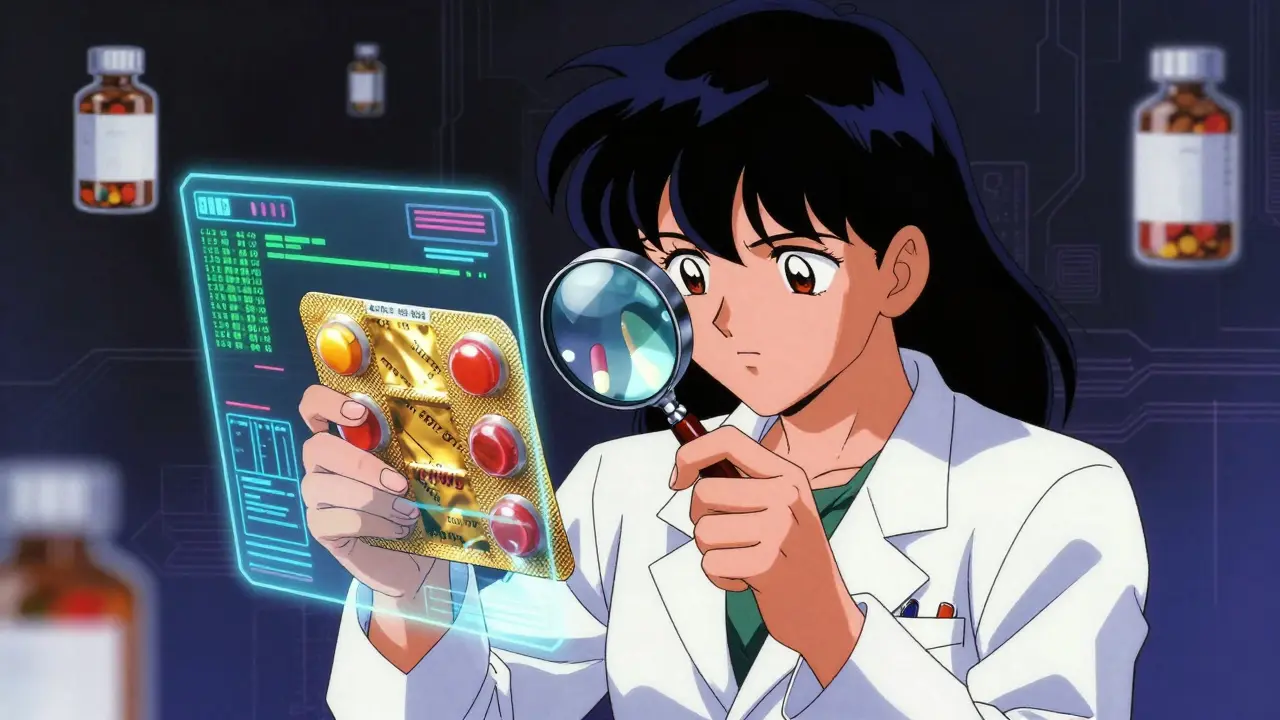
NIR spectroscopy is the gold standard. Devices like the Thermo Fisher TruScan® RM shine near-infrared light on a pill and analyze how it reflects. Real and fake drugs have different chemical structures, even if they look identical. This method detects differences in coating, moisture, or inactive ingredients - things that don’t show up on the label. Studies show it’s 92-97% accurate in catching counterfeits.
Raman spectroscopy works similarly but is better at identifying active ingredients. It’s great for spotting fake metformin or statins. But it struggles with dark-colored pills because the color interferes with the laser. These devices cost $20,000-$50,000, so they’re mostly in hospitals and regulatory labs.
And then there’s track-and-trace. The European Medicines Verification System (EMVS) handles over 2.5 billion verifications a year with 99.998% uptime. Every time a pharmacy scans a medicine, it checks against a central database. If the serial number has been used before, or if it’s not in the system, the system flags it. This system works because it’s centralized, standardized, and mandatory.
Why generics are harder to verify than branded drugs
Branded drugs like Lipitor or Humira have big budgets for security. They invest in holograms, RFID chips, and blockchain tracking. Generic manufacturers? Not so much. Generics make up 90% of prescriptions in the U.S. but only 22% of total drug spending. That means less money for anti-counterfeiting tech.
According to McKinsey & Company, implementing full track-and-trace systems costs generic manufacturers $500,000 to $2 million per product line. For a small company making low-margin pills, that’s a tough sell. So they cut corners - inconsistent labeling, no UV ink, no serialized codes. That’s why pharmacists report 68% more trouble verifying generics than branded drugs.
And it gets worse. Generics pass through 5-7 distribution points before reaching you. Branded drugs usually go through 3-4. More handoffs = more chances for fakes to slip in.
What’s being done to fix this
Progress is happening - slowly.
In 2024, the EU updated its Falsified Medicines Directive to require all generics to have cryptographic 2D codes by January 1, 2025. That means each code is digitally signed, making it nearly impossible to copy. The U.S. FDA is running a pilot with blockchain to track generics from factory to pharmacy. Early results show 99.2% accuracy.
Technology is also getting smarter. The new TruScan® RM Gen3 can scan a pill in 5 seconds with 98% accuracy. The Generic Pharmaceutical Association is pushing for 100% serialization of all U.S. generics by 2026, with $500 million in government funding to help small manufacturers keep up.
But the biggest hurdle isn’t tech - it’s access. In sub-Saharan Africa, 80% of clinics can’t afford even a $200 UV reader. In rural India or Nigeria, pharmacists still rely on visual checks - and miss 30-40% of fakes.
What you can do right now
You don’t have to wait for governments or manufacturers to fix this. Here’s your action plan:
- Always check your medicine - even if it’s from the same pharmacy. Don’t assume it’s safe.
- Ask your pharmacist: “Is this generic from a verified supplier?” If they can’t answer, go elsewhere.
- Report suspicious packaging to your national drug regulator. In New Zealand, that’s Medsafe. In the U.S., it’s the FDA’s MedWatch program.
- Buy from licensed pharmacies only. Avoid online sellers that don’t require a prescription or can’t show a physical address.
- Keep your old packaging until you’ve confirmed the new one is real. Comparison is your best tool.
There’s no single magic solution. No barcode, no hologram, no app can guarantee 100% safety. But a layered approach - visual check, UV light, barcode scan, and asking questions - cuts your risk by over 90%.
Real stories from the front lines
A community pharmacist in Christchurch recently received a shipment of generic lisinopril. The bottle looked perfect. But when she scanned the code, the system flagged it as “duplicate.” She called the supplier. They said it was a system error. She didn’t believe it. She sent a pill to a lab for NIR testing. The result? The active ingredient was 30% lower than labeled. She pulled the batch. Two days later, a patient who had taken it came in with dangerously low blood pressure. She saved a life by trusting her gut.
Another case: a man in Auckland bought generic sildenafil online. He took it. Nothing happened. He took more. His heart started racing. He went to the ER. The pills were fake - filled with powdered chalk and a tiny bit of real drug. He survived. But others haven’t.
Counterfeit drugs don’t just waste money. They kill.
How can I tell if my generic medicine is fake just by looking at it?
You can spot some fakes visually, but not all. Look for mismatched fonts, uneven colors, blurry logos, or labels that peel off easily. Check for color-shifting ink - tilt the box and see if the logo changes color. Compare it to your last bottle. Even small differences - like the position of the batch number or the thickness of a letter - can be signs of counterfeits. But many fake pills look perfect. That’s why you need more than just your eyes.
Do barcode scanners always work for generic medicines?
No. Barcode scanners work well for branded drugs because they’re fully serialized and registered in global databases. But many generics - especially from smaller manufacturers - don’t have consistent or complete serial numbers. Studies show barcode apps fail 40-50% of the time with generics. A “valid” scan doesn’t mean it’s real. Always combine scanning with visual checks and ask your pharmacist to verify the source.
Is UV light enough to confirm a medicine is real?
UV light helps, but it’s not foolproof. Many real generics use UV-reactive ink, but so do some counterfeits. Sophisticated fakes now include UV features to trick buyers. UV light is best used as one part of a multi-step check - alongside barcode scanning, packaging comparison, and asking your pharmacy for proof of supply. Don’t rely on it alone.
What should I do if I think my medicine is fake?
Stop taking it immediately. Keep the packaging and any remaining pills. Contact your pharmacist and ask them to report it to your national drug authority - Medsafe in New Zealand, the FDA in the U.S., or your country’s equivalent. Don’t throw it away. Authorities need the physical evidence to track the source. If you’ve taken the medicine and feel unwell, seek medical help right away.
Are online pharmacies safe for buying generic medicines?
Most aren’t. Over 96% of online pharmacies selling medicines without a prescription are illegal, according to the National Association of Boards of Pharmacy. Many sell fake or contaminated generics. Only buy from websites that require a valid prescription, display a physical address, and are licensed by your country’s pharmacy board. Look for the VIPPS seal in the U.S. or the verified pharmacy logo in New Zealand. If it looks too cheap or too easy, it’s probably fake.
Why don’t all generic manufacturers use advanced security features?
Cost. Generic drugs make very little profit - often just pennies per pill. Adding holograms, UV ink, or serialized codes can cost hundreds of thousands of dollars per product line. Many small manufacturers can’t afford it. Regulatory pressure is increasing, and by 2026, the U.S. aims to require full serialization for all generics. But until then, the system is uneven, and that’s what counterfeiters exploit.